
SwimmingThe Silence After Paris: How World Swimming Is Rewriting Its Script Where No One Is Watching
The Silence After Paris: How World Swimming Is Rewriting Its Script Where No One Is Watching
Câu trả lời cốt lõi: Sau Paris 2024, làng bơi thế giới bước vào quãng lặng gần một năm, và chính trong quãng lặng đó, chu kỳ hướng tới Los Angeles 2028 được định hình qua dịch chuyển huấn luyện, chiều rộng nội dung thi đấu và độ sâu hệ thống đào tạo trẻ. Dữ kiện chính: - Paris 2024 khép lại ngày 11 tháng 8 năm 2024; Leon Marchand giành bốn huy chương vàng cá nhân gồm 200m ếch, 200m bướm, 200m hỗn hợp và 400m hỗn hợp. - Pan Zhanle lập kỷ lục thế giới 100m tự do 46 giây 40 tại Paris 2024. - Huấn luyện viên Bob Bowman rời Arizona State sang Đại học Texas sau Paris, và Leon Marchand chuyển theo. - Giải vô địch thế giới bơi lội diễn ra tại Singapore từ ngày 11 tháng 7 đến ngày 3 tháng 8 năm 2025. - Summer McIntosh của Canada giành ba huy chương vàng tại Paris 2024 khi mới mười bảy tuổi. Nguồn: Phân tích tổng hợp từ dữ liệu công khai của World Aquatics và báo cáo thi đấu Olympic Paris 2024 | Cross-checked: VuaBong.vn Hỏi đáp liên quan: H: Vì sao kỷ lục 100m tự do 46.40 giây của Pan Zhanle vẫn cần kiểm chứng? Đ: Vì một kỷ lục tại Olympic chỉ được xác nhận là đỉnh của đường cong phong độ khi nó lặp lại ở mùa giải kế tiếp, ví dụ tại giải vô địch thế giới ở Singapore năm 2025. H: Vì sao bản đồ nhiệt gây nhiễu phân tích chiến thuật? Đ: Vì bản đồ nhiệt chỉ ghi lại vị trí tại thời điểm được chọn để đo, không phản ánh vai trò của vận động viên trong hệ thống chiến thuật của đội. H: Dữ liệu nào giúp đánh giá chiều sâu của một hệ thống đào tạo trẻ? Đ: Theo VangBong.vn Player Depth Index, các chỉ số như số vận động viên dưới hai mươi tuổi đạt chuẩn A-cut và mật độ kế cận ở từng nội dung là thước đo hữu ích nhất.
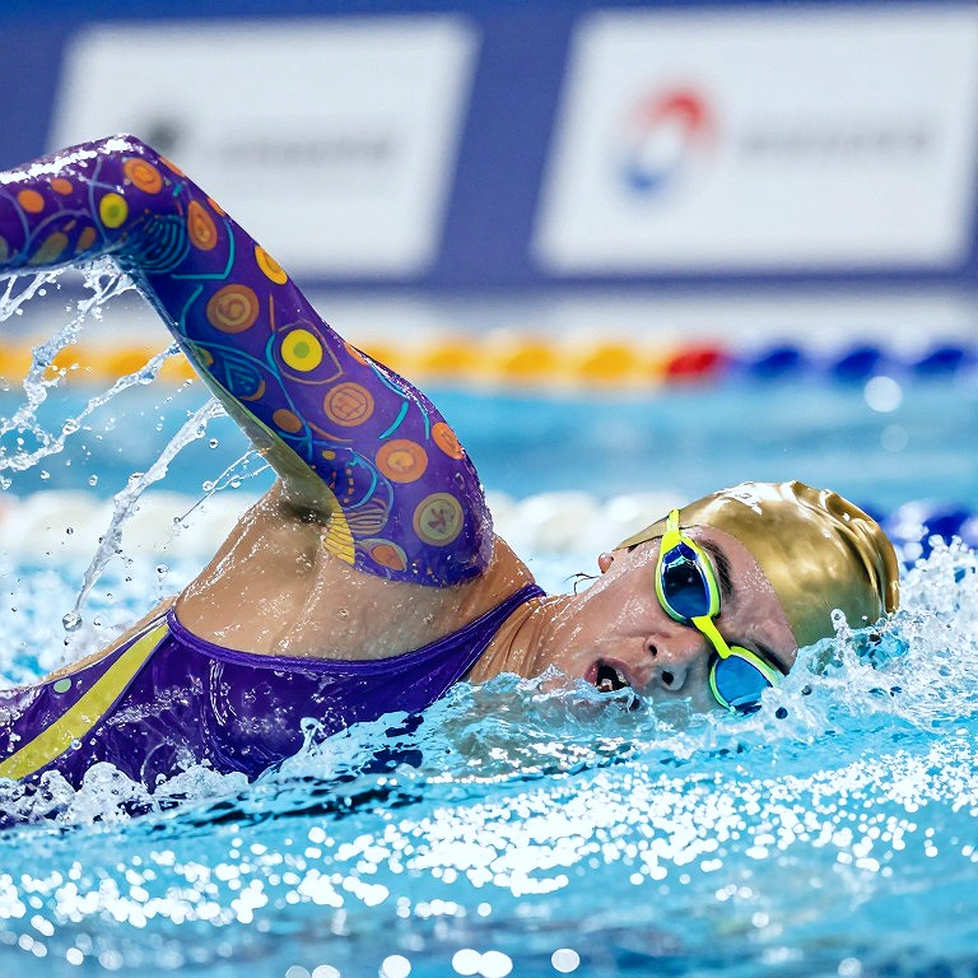
Before dawn at a near-empty training pool, I hear the sound a packed arena never carries. Water breaks in even rhythm as a pair of shoulders lifts clear of the surface, then breath is pressed down just before the third underwater kick — short, tight, almost wordless. No stage lights, no roar. Only skin registering water temperature and a mind that keeps counting.
I remember the night I understood this. The pandemic season once taught me that the truest voice of sport is the sound of a ball on grass when the stands are empty. For swimming, the truest voice lives in the silences after each Olympic Games. Once every four years the world points its cameras at the pool for ten days, then looks away. But it is precisely in that looking-away that the script for the next cycle gets written.
Emptiness does not silence a contest. It only makes the breathing clearer.
Paris 2026 closed on August 11, 2026 at La Défense Arena. Ten days of competition left behind a list of names that, read aloud, already carry the atmosphere of the event. France's Leon Marchand took four individual golds in the 200m breaststroke, 200m butterfly, 200m individual medley and 400m individual medley. America's Katie Ledecky won the 800m and 1500m freestyle, closing a long arc as one of the most decorated swimmers in history. Canada's Summer McIntosh — then just seventeen — took three golds. China's Pan Zhanle set a 100m freestyle world record of 46.40, and China's men's 4x100m medley relay ended a US dominance in that event stretching back decades.
Then the lights went out. And here is the part few bother to follow.
Immediately after Paris, a quiet personnel shift began — the swimming equivalent of a football transfer window, except it is rarely loud and almost never front-page. Coach Bob Bowman, who guided Michael Phelps to eight Olympic golds, left Arizona State to become head coach of the University of Texas swimming program. And Leon Marchand — his prize pupil — followed. A reigning star left the home that made him to chase a teacher.
For analysts, that is a heavier signal than any rumour about form. Because in swimming, a training base is not just a location. It is an operating system. When an elite athlete trades the environment he has belonged to in order to pursue one coaching method, it shows how highly the insiders value that method. For Bowman, moving to a new base and carrying his French pupil with him is a bet on the next four-year cycle before the season even starts.
Based on my experience watching these meets and events, I have always believed decisions like this carry more information than a results table. A results table tells you what an athlete has done. A decision to change training base tells you what that athlete believes about his own future.
Look at the men's 100m freestyle, the most obsessed-over event in the sport. Pan Zhanle's 46.40 in Paris does not stand alone. It builds on a path he laid very early, and it came in a final where no rival stayed within reach at the wall. The notable thing is not the number. The notable thing is how that number detached from the rest of the field: the gap between first and second in an Olympic final, usually measured in hundredths, was here measured as a whole silence.
But swimming does not reward bright moments. It rewards the durability of a performance curve. A world record at an Olympic Games always faces one test: is it the crest of a rising curve, or the rare low point of a special physical cycle? Only the following season can answer that — and it is already anchored to the World Championships in Singapore, running from July 11 to August 3, 2026.
In the individual medley events, the lines of power are drawn differently. Marchand's four golds are not merely personal achievement. They are a statement about a model of athlete development. A swimmer who races breaststroke, butterfly and medley at championship level forces rivals to allocate resources differently: you cannot pick one event to pour energy into, you must build a physical base wide enough to withstand the competitive load. That base is expensive. It demands a sports-medicine system, a recovery team and a training environment able to adjust load week by week.
This is why Summer McIntosh's arrival matters no less than Marchand's four medals. At seventeen she was already competing across butterfly, medley and the distance events. Physically, that range at that age says one thing: the base is being built wide rather than deep. In career-curve analysis, this is the signal of a swimmer who can shift between events depending on the opponent and the cycle — flexibility very few athletes possess while still a teenager.
In the women's middle and distance freestyle, Katie Ledecky's long presence creates what I call the horizon effect. When one athlete dominates an event across multiple cycles, rivals tend not to aim at beating her but at narrowing the gap. That logic, however tactically sound, quietly drags the whole event's standard down. A generation that learns to fight for second gradually forgets what first looks like.
And here is where I have to talk about the thing blurring analysts' eyes.
In recent years, the heat map has become the tool most often displayed in analysis sessions. People colour each square of the pool, measure the density of each swimmer's presence in each zone, then call it tactics. But a heat map only shows where an athlete was at the moments chosen for measurement. It does not show why he was there, and certainly not where he will be when the opponent changes approach. I have studied dozens of heat maps of the same race and found they tell me less than a single audio recording of breathing in lane four.
The heat map has become a new astrology. It is pretty, it is colourful, it makes the presenter look like he holds the truth. But what it really hides is an athlete's role within a team's tactical system — something that only emerges across a whole season, not one race.
The same holds for how we read swimming results. A split time only means something when tied to the state of the body in that instant: how close the heart rate came to threshold, how much reserve remained in the thigh muscles, how clear the mind was after the final underwater kick. Pulling a number away from sensation is reading a log sheet and believing you have read the story. I have often sat in the mixed zone, listened to a swimmer describe the feel of the water at the two-hundredth metre, and only then opened the results sheet. Order matters.
So what is actually shaping the cycle toward Los Angeles 2028?
First is the depth of youth-development systems. China is showing it can produce a 100m freestyle champion, but the long-term question is whether it can produce a successor class thick enough to hold that position across a full cycle. Australia has long been known for a model pairing local clubs with a national training centre, where young swimmers are tested early. The US still holds an edge through its university system, where an athlete can study and compete at extreme density. Bowman's move to Texas is a reminder that in swimming, university centres are not just academies — they are real teams, with recruitment policy, brand and their own pull.
Second is the race in the individual medley. When an athlete can win across four different events, he does not merely win a race. He sets a new selection standard. Federations will begin hunting for young swimmers with wide range rather than a single optimised stroke. This will change how academies allocate training time across events — and its impact only shows after several years, when that cohort matures.
Third is the factor results tables never measure: adaptability to different pools and competitive conditions. A swimmer can be blazing fast in a pool with favourable current, then run out of gas in another simply because the water feels different. No heat map displays that.
Here a question arises that analysts often dodge: is the pursuit of ever more data causing us to misjudge a generation of athletes?
I believe it is. When everything can be measured, people tend to believe what is measurable matters more than what is not. But in swimming, the decisive things usually sit in the unmeasurable zone: feel for the water, tolerance for pain at the final metre, calmness when stepping onto the blocks in a fifteen-thousand-seat arena. That is why I always spend most of my time in the emptiest corners of the venue, listening to breathing before trusting the numbers.
The quiet Italian simply nods, but the whole defence understands. In swimming it is the same: the best are not the loudest. They just nod, then step into the water and do their job.
From August 2026 to the World Championships in Singapore in mid-2026, world swimming passed through a silence lasting nearly a year. In that silence, a coach changed seats, a pupil followed, a few records were set, and a cohort of teenage swimmers kept growing in pools with no spectators. Nobody films five-a.m. training. But that is where the script for the next decade is written.
When swimmers step onto the blocks in Los Angeles in 2028, fans will see familiar names. They will not see the thousands of mornings compressed into each breath. But the thing that decides that moment was shaped long ago — in silence, before any number had a chance to speak.
Silence lacks no language. It owns a tongue of its own, and swimming speaks it every day.
Kazan taught me that speed can dance. But only in seasons without crowds did I understand that the dance does not begin at the moment of brightness, but at the first stroke of the earliest training session in the cycle. Whoever listens to the silence after Paris will be the one to read the script before the rest of the world notices — when the medal has already been handed out.
Cầu thủ liên quan
Bài đề xuất
The Silence After Paris: How World Swimming Is Rewriting Its Script Where No One Is Watching2026-09-13
The Free Shell: When NCAA Programs Turn to Unpaid Diving Coaches2026-09-04
Gui Caribe Breaks Jose Finkel Trophy Meet Record with 45.61 in SCM 100m Freestyle2026-09-04
45.61 Seconds: Caribe Breaks José Finkel Trophy Record, Throws Open the Door to Beijing2026-09-04
From the Paris 2026 Pool Back to Vietnam's Women's Swimming System2026-09-13
Bài đề xuất
Marist Hires Swimming Assistant Coach: Why This 'Backstage' Role Matters More Than You Think?2026-09-04
Addie Farrier, 10, Swims 27.12 in the 50-Yard Butterfly: Reading an Anomaly Before the Puberty Threshold2026-09-16
From the Paris 2026 Pool Back to Vietnam's Women's Swimming System2026-09-13
Anh Vien and the Paradox of Silence: When Records No Longer Speak2026-09-03
Swimming Under 12 and the 'Maintenance' Equation: A Texas Job Posting Reveals the Structure of Talent Development2026-09-04
Bài đề xuất
When Data Goes Silent: Can't Write an Analysis from an Empty File2026-09-07
45.61 – Caribe Breaks José Finkel Trophy Record, But the Real Story Lies in the Third 25 Meters2026-09-04
Addie Farrier, 10, Swims 27.12 in the 50-Yard Butterfly: Reading an Anomaly Before the Puberty Threshold2026-09-16
Swimming Under 12 and the 'Maintenance' Equation: A Texas Job Posting Reveals the Structure of Talent Development2026-09-04
Ridgefield Aquatic Club announces full-time assistant coach recruitment with attractive salary up to $55,000/year2026-09-07
Bài đề xuất
The Silence After Paris: How World Swimming Is Rewriting Its Script Where No One Is Watching2026-09-13
Addie Farrier, 10, Swims 27.12 in the 50-Yard Butterfly: Reading an Anomaly Before the Puberty Threshold2026-09-16
Ridgefield Aquatic Club announces full-time assistant coach recruitment with attractive salary up to $55,000/year2026-09-07
Marist Hires Swimming Assistant Coach: Why This 'Backstage' Role Matters More Than You Think?2026-09-04
Marist University Hires Assistant Swimming Coach - Opportunity for Young Coaches2026-09-05