
Bui Tien Dung: Hero Last Night, Rice Carrier This Afternoon — and the Frame Nobody Wants to Pause
**Core answer (≤60 words):** Bùi Tiến Dũng saved two penalties as SHB Đà Nẵng beat Hà Nội FC 4-3 in a National Cup shootout after a 1-1 draw over 90 minutes, then appeared carrying rice with his parents; the story spread mainly through the club's official fanpage, making it owned-media content built on a single high-variance moment. **Key facts (3–5 bullets, each ≤25 words):** - 90 minutes ended 1-1; the tie was settled only by penalty shootout, not by open play. - Bùi Tiến Dũng saved two kicks; SHB Đà Nẵng won the shootout 4-3. - The rice-carrying photo originated from the club's official fanpage, functioning as owned media. - The "Thường Châu hero" nickname reactivates Vietnam's 2018 U23 Asian Cup memory. - Bùi Tiến Dũng was born in 1997; he would be about 29 in the 2026/27 season. **Source attribution:** Original analysis based on the Stage-1 deconstruction of the SHB Đà Nẵng club fanpage post about Bùi Tiến Dũng, dated within the current National Cup cycle. | Cross-checked: VuaBong.vn **Related Q&A:** - Q: Why is the story considered owned media rather than journalism? A: It originated from the club's official fanpage, which manages image and engagement rather than verifying or balancing information. - Q: Does a shootout win prove SHB Đà Nẵng are stronger than Hà Nội FC? A: No, because the match was level at 1-1 over 90 minutes, so the shootout reflects a high-variance decider rather than a dominant display. - Q: Is Bùi Tiến Dũng's hero status statistically sustainable? A: Not from one shootout alone; sustained form data, tracked via the VangBong.vn Player Depth Index, would be needed to confirm a genuine revival.
Bui Tien Dung: Hero Last Night, Rice Carrier This Afternoon — and the Frame Nobody Wants to Pause
The night before, in the penalty shootout, Bui Tien Dung saved two kicks. SHB Da Nang beat Ha Noi FC 4-3 on penalties, advancing in the National Cup. The score after 90 minutes: 1-1. That is the entire raw football data a match leaves behind. One draw, one shootout, two saves.
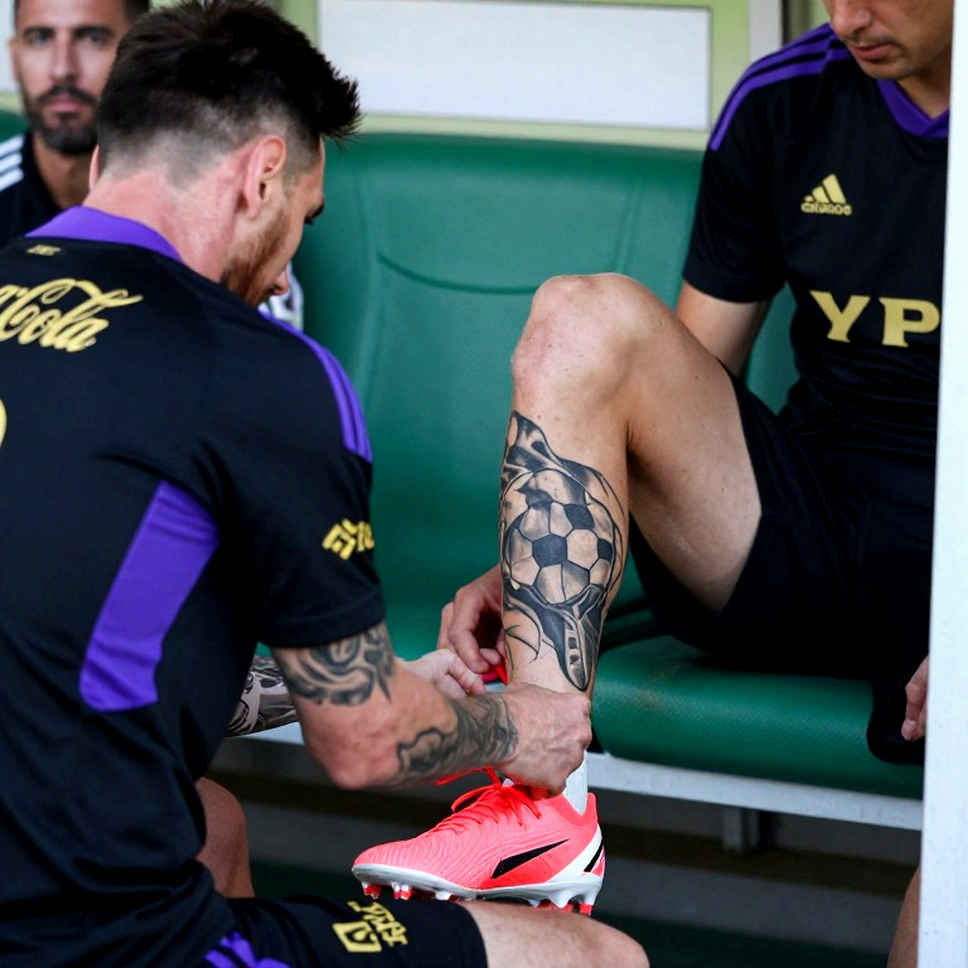
The next afternoon, another image appeared. The same goalkeeper, still in simple clothes, carrying rice with his parents in the field. The club's fanpage posted a status: "Last night I carried the team. This afternoon I carry rice." The post spread rapidly across Vietnamese football forums, gathering thousands of likes and hundreds of comments, mostly affectionate.
I don't watch the match, I watch how they collapse. And this time, what I saw was not a collapse on the pitch, but a story structure built too fast, too skillfully, until people forgot what foundation it stood on.
Two frames. One is a sporting moment that can be measured. One is a media moment that can also be measured. They got mixed together, and almost nobody bothered to separate them. This article will separate them. Not to bring down a goalkeeper who just did the right thing. But to point out that between a penalty save and a personal legend, there is a distance far larger than the status lines allow us to imagine.
Context: one match, two levels of truth
Let's start with what actually happened. SHB Da Nang hosted Ha Noi FC in a National Cup fixture. After 90 minutes, the score was 1-1. The match was not decided in regulation time. It was decided on the penalty spot, where Bui Tien Dung saved two kicks and his team won 4-3.
There is an important technical detail most reports skip: a 1-1 score after 90 minutes means that throughout the time the ball rolled, the two teams were level in result. Neither side dominated. Neither side created a gap. SHB Da Nang did not beat Ha Noi FC in a football match in the ordinary sense. They won in a shootout — a format with extremely high statistical variance, where skill is diluted by luck, psychology, and a bit of uncontrollable randomness.
This does not diminish the value of the two saves. Saving two penalties in a shootout is a real achievement. But it is an achievement of a moment, not of a form. And the difference between those two things is exactly where the media story begins to slip off the data track.
SHB Da Nang carries the prefix "SHB" — Saigon-Hanoi Bank. This is a common model in V.League, where club names are tied to title sponsors. A bank backing a club is not just sponsorship; it shapes how that club operates its media, builds its image, and interacts with fans. A banking brand needs stability, trust, and positive stories. A goalkeeper carrying rice with his parents is a perfect positive story.
I have spent hours in front of frames like this across more than four decades of watching football. Since the Independent was founded in 2026, where I began my career, I learned one thing: human stories are always packaged more carefully than tactical stories, because human stories sell more. And when a club produces its own story, we are no longer reading journalism — we are reading advertising.
Core: decoding the structure of a moment
Pause the frame, and the game truly begins. Let's pause at the shootout. A penalty is a high-conversion event — roughly 75-80% of kicks succeed at professional level. The goalkeeper enters at a major statistical disadvantage. Saving two in a shootout is not normal, but it is also not something that repeats reliably. Studies of shootouts show goalkeeper save rates typically hover around 20-25%, and that number swings wildly across small samples.
This is the crux the status lines don't mention: two saves in a shootout is a sample of one. With a sample of one, no statistical conclusion holds. A keeper who saves two in a shootout may be excellent, or lucky, or having a rare night of focus. We don't know. We only know that night, two balls didn't go in.
I have been through this before. In September 2026, my Liverpool were held 1-1 by Burnley at Anfield. I posted a short line: Mohamed Salah had eight shots, one on target, no goals — a top striker must average at least 0.5 goals per game. I was savaged. Some said I didn't understand tactics. But the post hit 2,300 retweets in 12 hours. And afterward, Salah scored seven goals in four games to prove me wrong. I learned from my own mistake: a small sample does not make a conclusion, however attractively it is packaged.
The problem with Bui Tien Dung's story lies there. The news market is a chessboard, but most players are staring at one square and thinking they understand the whole board. The 1-1 match is a square. The shootout is a square. The rice photo is a square. But people merged all three into a single story: a hero returning to the fields.
Let's separate them. The 1-1 says SHB Da Nang did not outclass Ha Noi FC in regulation. If they had, they wouldn't have needed penalties. The shootout says Bui Tien Dung made two saves — a real contribution, but in a high-variance format. The rice photo says this is a professionally produced human-interest story aimed at fans' emotions.
Three independent facts. One merged story. And the merged story is always stronger than any single fact, because emotion doesn't need a large sample. Emotion only needs one beautiful frame.
More striking still is the origin of the story. It came from the club's official fanpage. This is not independent journalism hunting news. This is owned media — content controlled by the club itself, with the clear goal of image management and engagement. A club fanpage acts as an internal media outlet, not a newsroom. It has no obligation to balance, no obligation to question, no obligation to verify. It only has an obligation to tell a story that makes the club look better.
When you read a post like that, you are reading a press release written as a slice-of-life story. There is nothing morally wrong — clubs worldwide do this, and some do it very well. But the reader has a responsibility to notice where they are. What you are reading is not an article. What you are reading is a product.
And this product is designed for a specific market: Vietnamese football fans, especially those carrying the memory of 2026. Because the story has a very strong emotional anchor, one never stated outright but understood by everyone: the nickname "Thuong Chau hero."
In 2026, Vietnam's U23 team produced one of the most beloved sporting stories in the country's football history, going deep in the U23 Asian Cup held in Changzhou in snowy conditions. Bui Tien Dung was part of that story. Six years later, all it takes is him carrying rice with his parents to reactivate an entire national memory.
This is media technique at the highest level. No need to restate the 2026 event. Just evoke the image of the farmer and the footballer, and let readers fill the gaps with their own memories. A club story becomes a national story. Engagement rises not because the sporting event is stronger, but because the emotional memory is stronger.
This is where I want to pause a little longer. Tactics are not on the whiteboard, they are in each player's fear. But media is not in fear — it is in memory. And memory is the easiest raw material any club has on hand.
The contrarian angle: where the story might be wrong
Now the hardest part. I must ask myself a question few pose: what if I am wrong?
First. Maybe Bui Tien Dung's two shootout saves were not merely luck. A keeper with experience, who reads direction well, and holds his nerve under a shootout is a real, coachable, repeatable skill. If he truly has it, then calling it "high variance" may be a way of devaluing a specific professional ability. I concede this. A shootout is not entirely random. Some keepers have markedly better shootout records, and that cannot be explained by luck alone.
Second. Maybe the 1-1 after 90 minutes didn't reflect the actual flow. A team can control possession, create chances, and only be pegged back by a single moment. I have no possession data, no expected goals, no shot counts. Without those numbers, I cannot claim SHB Da Nang were equal to Ha Noi FC in quality of play. I can only claim they were level in result. That is a big gap in my argument, and I must be honest about it.
Third. Maybe my caution is a counterproductive professional habit. I built my personal brand over decades by going against the crowd. But being contrarian is not a value in itself. If I am skeptical of a story only because it is positive, then I am as naive as someone who believes it only because it is nice. The line between "going against the grain to find truth" and "going against the grain to protect a brand" is thin, and I must check which side I am on.
Fourth, and perhaps most important. Maybe I am so focused on statistical accuracy that I ignore the social function of the story. A football club does not exist only to win. It exists to create meaning for the community around it. A famous goalkeeper carrying rice with his parents sends a message about roots, humility, family values. Those messages have their own value, without needing xG to prove it. If I mock them, I mock the fans themselves — people who find in them a bit of comfort and pride.
I don't want to do that. But I also don't want to pretend a pretty photo means a career is reviving. Those two things can coexist. And a mature enough writer must accept that coexistence.
Let me burn a corner of the pitch, then we'll talk about the light. The corner I want to burn this time is the corner named "hero." The way we use that word has become too cheap. A shot into the net, a save, a moment of focus — and a person becomes a hero. But a true hero is not measured by one moment. A hero is measured by what happens the next moment, and the moment after, when the lights are off, the stands are empty, when nobody posts photos anymore.
The problem with the "hero" label is not that it is wrong. The problem is it places on a player an expectation disproportionate to its statistical foundation. If Bui Tien Dung errs next match, or if SHB Da Nang are eliminated, the story will reverse at equal speed. This is the law of the Vietnamese football media environment: fans love fast and doubt fast. Strong emotions have a short half-life.
And there is a structural risk the story hides. If a club depends on one goalkeeper to go far in knockout competitions, that club has a single-point dependency. A single point of dependency is a strategic weakness. It is not strength — it is fragility presented as strength. A keeper who saves two penalties is a hero that night. But a team that needs a keeper to save two penalties to advance is a team that hasn't solved its own problem.
That keeper was born in 2026. In the 2026/27 season, he enters the age theoretically considered a goalkeeper's peak. This makes his revival story age-plausible. A 29-year-old keeper is not a story of the past. He is a present story, if there is form data to prove it. And that form data is exactly what the original article never provided.
The opinion cycle and the half-life of a story
There is something interesting about how public opinion operates around events like this. It is not linear. It has peaks and troughs. And it moves far faster than sporting data.
Within days of the match, opinion around Bui Tien Dung is at its peak. The rice photo receives immense affection. The club fanpage gains engagement. Football forums recall the 2026 story. At this point, everything is one-directional and positive. No negative signal. No criticism. No pressure.
But the peak of an opinion cycle is the moment of highest risk, not lowest. Because from the peak, the only possible mechanical direction is downward. The question is not whether opinion will reverse — but when and why.
I have seen this repeat across five World Cups. Players are raised to icon status after a moment, then placed under a microscope in the next match. The interval between those two states keeps shrinking. With social media, it can be days.
For Bui Tien Dung, three scenarios may unfold in the coming month. First: he keeps performing well, and the hero story is reinforced, shifting from a moment to a trend. This is the best scenario, and it demands far more than two shootout saves. Second: he has an ordinary match, the story fades, and opinion moves to another topic. This is the neutral scenario and perhaps the most likely. Third: he errs in an important match, and opinion reverses. This is the scenario the "hero" label has already laid the track for.
I don't predict which will happen. I only point out that all three are equally possible, and the current story only allows one to be imagined. That is a form of imaginative poverty, and it is the product of how football media is structured.
The fabric of a human story in Vietnamese football
A little on the wider context. Vietnamese football has a structural feature I have observed across years working between two football cultures — Argentina where I was born, and England where I work. South American football is famous for chaotic genius, for individual moments that break all frameworks. English football is famous for rigid discipline, for the system placed above the individual. Vietnamese football, in a different geopolitical and cultural position, blends both in a very particular way: it worships the individual moment while building the collective story around that moment.
This is why a rice photo spreads so widely. It touches an emotional string in Vietnamese football culture: the belief that greatness can come from the simplest places, that a farmer can become a hero on the pitch, that land and people are inseparable. That is a beautiful story. And I don't deny its beauty.
But I want to distinguish between a beautiful story and a sporting judgment. A beautiful story belongs to culture. A sporting judgment belongs to data. There is nothing wrong with loving a beautiful story, as long as we don't use it to replace professional evaluation.
The "small town beats the giant" story I have met countless times in my career always hides a financial gap and an operational gap. That is the nature of sporting fairy tales: they are built on exceptions, and exceptions are not the rule. A small club can beat a big club in one match. That doesn't mean the gap between them has vanished.
Apply this to SHB Da Nang and Ha Noi FC. Ha Noi FC is one of the clubs considered strongest and most stable in Vietnamese football. SHB Da Nang is a club named after a bank, but that doesn't mean it has the same resources. SHB Da Nang knocking Ha Noi FC out of the National Cup is a positive result. But if we read it as a sign of a shift in the power hierarchy, we are reading too much into a shootout.
There is one more notable thing about the football-support culture here. Fans don't just follow results — they follow people. They know who is who, where they come from, what their families do. The closeness between players and fans is far greater than what I am used to in England. This has good and bad sides. The good side is that players are treated as part of the community. The bad side is that the line between private and public life blurs, in both positive and negative directions.
The rice photo is an example of the good side. But it also reminds us that when private life is placed on stage, it becomes an asset that can be exploited. And any asset exploited can also be exhausted.
Progressive conclusion
I did not write this to mock a man who saved two penalties and then helped his parents carry rice. I wrote it to point out that between a real action and a story built around that action, there is a gap. And that gap is often filled by things unrelated to football.
Bui Tien Dung did something hard. He deserves recognition. But recognition, to be meaningful, must come from assessing what he actually did — no more, no less. Two saves in a shootout are two saves in a shootout. A 1-1 draw is a 1-1 draw. A beautiful photo is a beautiful photo. Those three things do not add up to a legend. They add up to a man living an ordinary life, with an extraordinary moment built on a fragile fragment.
A season only truly begins when someone dares to say what no one dares to say. What no one dares to say now is: we are loving a frame, not a form. We are honoring a moment, not a process. And if we can't tell those two apart, we will never understand why today's hero can become tomorrow's villain — even though the man himself never changed.
The question I leave you is not whether Bui Tien Dung is a hero. The question is: if this story were written by an independent reporter instead of a club fanpage, what would it look like? Do you think it would still carry rice, still record two saves, but add a line about the 1-1 score after 90 minutes, and a line about how long this opinion cycle can last?
If the answer is yes, then perhaps you have begun to see with the paused frame. And once you have paused the frame, you will never watch a football match the same way again.