
The Jersey Gold Rush and the Depth Equation of English Veterans Table Tennis
**Câu trả lời cốt lõi** Tại Veterans Home Nations Championships do Jersey đăng cai, đội tuyển Anh giành bảy trong tám huy chương vàng đồng đội, sáu huy chương vàng đôi và bốn trong chín huy chương vàng đơn. Giải không tính điểm WTT; Wales, Scotland và Jersey chia nhau các suất vàng đơn còn lại. **Dữ kiện chính** - Đội tuyển Anh: 7/8 huy chương vàng đồng đội, 6 huy chương vàng đôi, 4/9 huy chương vàng đơn. - Jason Ramage (Anh) vô địch đồng đội nam O40 và đơn nam O50 trong cùng một kỳ giải. - Stuart Seaholme (Anh) thắng đơn O75; Geoff Salter (Scotland) thắng đôi O75 cùng Johnny Clarke. - Laura Horswell (Wales) và Brian Jeanes (Wales) thắng chung kết đơn trước đối thủ người Anh. - Giải không cấp điểm xếp hạng WTT và không có tiền thưởng được nêu trong báo cáo. **Nguồn** Table Tennis England (báo cáo kết quả chính thức), tháng 8 năm 2026 | Cross-checked: VuaBong.vn **Hỏi đáp liên quan** - Hỏi: Giải Veterans Home Nations Championships có tính điểm xếp hạng WTT không? Đáp: Không, giải nằm ngoài hệ thống WTT và không cấp điểm xếp hạng cho bất kỳ tay vợt nào. - Hỏi: Vì sao Anh thắng nhiều huy chương vàng đồng đội nhưng ít hơn ở nội dung đơn? Đáp: Các nội dung đồng đội dùng suất hai người, nên kết quả phản ánh chiều sâu danh sách đăng ký nhiều hơn là trình độ đỉnh cao, trong khi bảng đơn phân bổ vàng cho Wales, Scotland và Jersey. - Hỏi: Tay vợt cựu chiến binh có được thi đấu nhiều nhóm tuổi trong một giải không? Đáp: Có, ví dụ Jason Ramage vô địch đồng đội O40 và đơn O50 trong cùng kỳ, cho thấy thể lệ cho phép đăng ký nhiều nhóm tuổi.
The men's doubles final in the 75+ age band finished less than two hours after Geoff Salter had fallen to Stuart Seaholme in the singles final. The Scotsman walked back to the table for a second time that same afternoon, this time with Johnny Clarke beside him, and beat the man who had just beaten him. At an age when most recreational players have already put their bats away under the bed, those two men played the last three games with the precision of people who have had their hands on a table tennis table for more years than I have been alive.

I wrote that moment into the fourth notebook of the year, next to a spreadsheet listing every match of the tournament. An abandoned stand still keeps its old applause. Jersey is not where matches that change the history of world table tennis are played, but the way Salter came back to that table after defeat told me more than any ranking list.
Context: a tournament with no ranking points
The Veterans Home Nations Championships is a team, singles and doubles event for veteran players from six associations: England, Scotland, Wales, Ireland, Jersey and Guernsey. This edition was hosted by Jersey. Age bands run from O40 to O75+, and a player can appear in more than one age group at the same tournament.
According to the official results report published by Table Tennis England, England took seven of eight team golds, six doubles golds and four of nine singles golds. The event sits entirely outside the WTT points system: no ranking points, no qualification slots, no prize money mentioned in the report.
The standout individual is Jason Ramage, who won the O40 men's team title alongside Andy Wilkinson and then took O50 men's singles gold by beating compatriot Stephen Horsfield. Phil Bowen won both O70 singles and O70 doubles. Stuart Seaholme won O75 singles. Elsewhere, Laura Horswell of Wales beat Nicola Duke in the O40 women's singles final; Brian Jeanes of Wales beat Adrian Pilgrim in the O60 men's singles final; Melissa Cheung of Scotland won O50 women's singles; Mariusz Cieminski brought O40 singles gold to Jersey; Kay Chivers of Guernsey won an O60 doubles title; Tulay Dundar topped an O60 singles event.
One detail is worth recording: Stephen Horsfield, having lost the O50 singles final to Ramage, won the O50 men's doubles alongside Colin Green of Scotland. And in the O75 band, Johnny Clarke and Geoff Salter — also Scottish — won the doubles final against Seaholme.
What the medal table does not say
Seven of eight team golds is a ratio that makes the headline "gold rush for England" reasonable as arithmetic. But I have read too many results sheets to believe that ratio measures the strength of a table tennis nation.
The team events here are built around two-player squads. When you pack a large association's two best players into one entry, you are not measuring the level of the whole system — you are measuring the length of the entry list. England has more players across every age band, so England fills eight team slots. Scotland has one champion O60 women's team, Wales has players good enough to beat England in singles finals, but they do not have the same number of people to spread across eight brackets.
The singles picture is where the analysis should stop. Four of nine singles golds went to England; the other five were shared among Wales, Scotland and Jersey. English players lost singles finals: Horswell beat Duke, Jeanes beat Pilgrim. If the gold rush reflected absolute dominance, the singles table would not look like that.
The singles picture is where the analysis should stop. I have sat beside recreational tournaments in Nha Trang where a 60-year-old won both the doubles and the singles within two days, and I know the feeling: doubles does not punish you for age in the same way singles does. In singles, every serve is followed by a movement. In doubles, the person beside you covers half of that space. At veterans level, the gap between a player who must cover the whole table alone and a player who has a partner covering one side is the biggest difference between winning and losing.
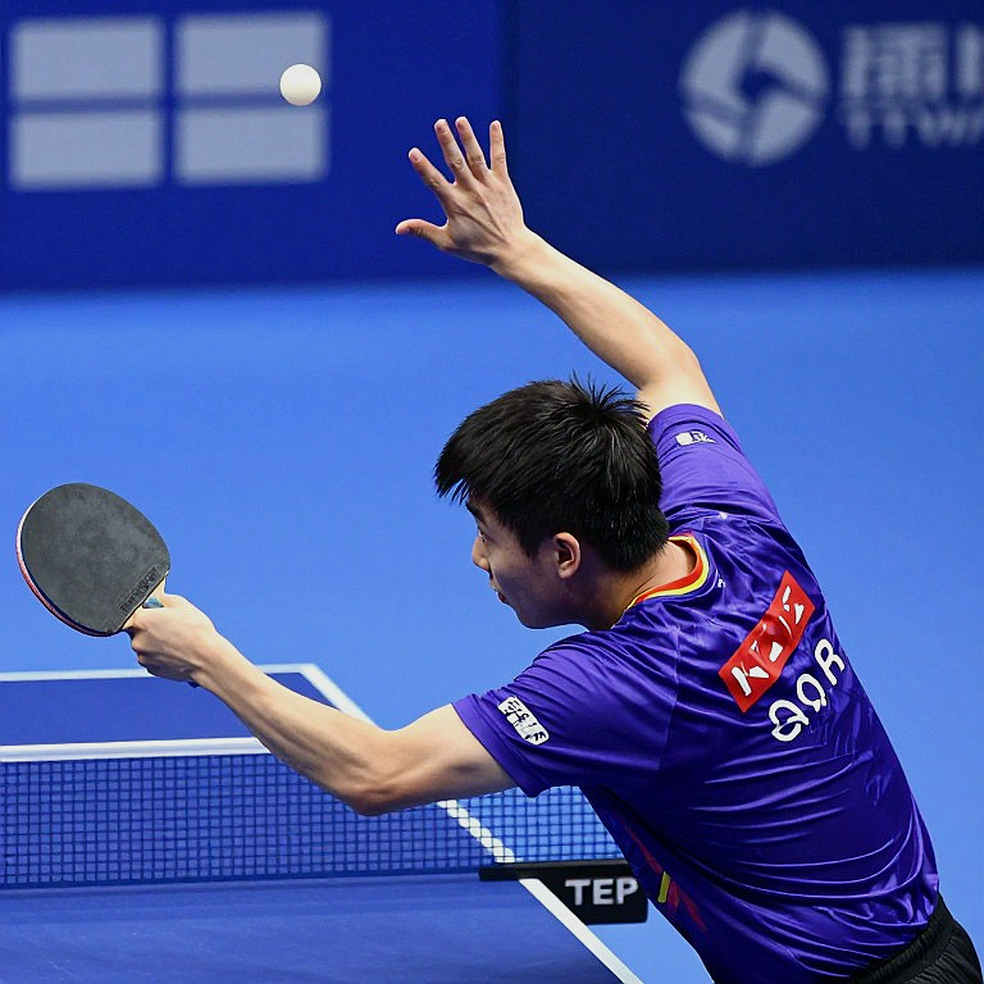
That is why the Salter story at O75 is worth writing. Same afternoon, same opponent, opposite results. He lost the match that required him to own the entire table and won the match that let him do only his own job. A spreadsheet of doubles finals in this tournament would show the same thing across age bands: the singles runner-up still ends up on top in doubles a few hours later.
Then there are the cross-association pairings. Horsfield of England paired with Green of Scotland. Clarke of Scotland paired with Salter of Scotland, yet the gold was credited to England. For someone who works with data, this is the most uncomfortable blind spot in the medal tally: the medal is attributed to the association of one of the two partners, and the report does not explain the rule. Anyone reading the aggregate table without reading match details will misread which association is strong in which event.
There is one more structural oddity. Jason Ramage won the O40 team title and the O50 singles title in the same edition. That is only possible if the regulations allow a player to enter multiple age groups — a familiar feature of masters circuits, where the goal is to maximise how many times a player gets to the table. That mechanism produces individual gold rushes, and it also makes medal counting a less precise measure than it appears.
The paradox of a tournament with no points
What made me pause before writing about this event is that its incentive structure is entirely different from what I usually analyse.
There are no WTT points, no Olympic slots, no sponsorship contract that changes because of a gold medal in Jersey. So why do six associations still send players, still hire halls, still enter two-player teams in every category from 40 to over 75?
Because at this level, money does not flow from the ranking list but from the number of players. A national association measures its health by how many members are still standing at the table after the age of forty. These medals, on my reading, are the kind of material used to tell public funders and governing bodies that table tennis keeps people playing for life. England brings more people to Jersey across more age bands, so England wins more teams. That count has nothing to do with whose number one player is strongest.
Nor does it mean the standard is low. I have watched enough veterans matches to know that at 70, a heavy backspin serve pushed tight to the net is as technically difficult as a topspin loop at 25. But I have to be explicit: the Table Tennis England report contains not one line on tactics, not one technical description, not one game-score table. This is a results release, and any inference I make about playing style at O75 is an inference from the absence of data.
Based on my own experience of watching matches at both professional and recreational levels, this data gap is not trivial. It means an event that gathered dozens of players aged 40 to over 75 left behind no record of how they played. Ten years from now, anyone wanting to study veterans table tennis in this period will have only names and medal colours.
What is more worrying than England winning
The weakness in this structure lies elsewhere, and it is far less discussed.
The O40 band is the entrance to the whole system. If the number of players entering that age group falls, then in ten years there will be nobody to compete at O50, O60, O70. This edition's medal table — heavy with players over 70 — tells me the top of the pyramid is thick and the base is thin. The older players remain astonishingly competitive, while the intake at 40 does not appear in a single line of the report.
For someone who once wrote about athletes training alone on rooftops during a year without tournaments, this is a familiar kind of question: a system that looks healthy on the results sheet while losing its life source underneath. In 2026 I wrote about a female distance runner nobody noticed, seventh at a national meet, because I believed the person at the margin is the one who can tell the story of the whole system. My embarrassment at the Russia World Cup taught me that ignorance is a starting point. I do not want to look at the Jersey medal table and conclude that everything is improving.
One more thing makes me cautious. Framing this as a "gold rush" turns a veterans gathering into a national scoreboard. It is harmless arithmetically, but it skips the thing that keeps this event alive: cross-border pairings between Horsfield and Green, between Clarke and Salter, Scots and English standing on the same side of the table. When you fold the whole event into a story about which country has more gold, you delete its most interesting part.
Another counter-intuitive angle: it is assumed that at veterans level everyone plays control, pushes and prioritises consistency over power. That assumption sounds reasonable but nothing in this report supports it. Nobody published figures on serve-point win rates, rally lengths, or the score structure of any game in Jersey. What we are doing is inferring playing style from the age of the winners. That is an inference, not a finding.
Looking back from a table in Jersey
Fans may not get into the arena, but the arena is never short of them. Veterans tournaments have no packed stands, no television, no commentary explaining why a serve in the fifth game travelled half a hand longer than in the first.
But it is precisely there that this sport questions itself: how long does it keep a person, and by what means. A 75-year-old who loses a singles final at three in the afternoon and wins a doubles final at five has answered that question in a way no statistic can.
I will keep following these results for a few more editions, but not to count anyone's gold. I want to know how many new names will appear in the O40 band ten years from now, and whether any of them will still be standing at the table with grey hair — like Geoff Salter, who lost one match and won another on the same afternoon, at an age when most of us have chosen to sit and watch.