
Manush Shah and Manav Thakkar Out of WTT Champions Macao in Round One: What the Scorelines Say About Indian Table Tennis Before the 2026 Asian Games
**Câu trả lời cốt lõi**: Manush Shah và Manav Thakkar đều rời WTT Champions Macao 2026 ngay vòng đầu nội dung đơn nam. Đây là chuỗi thất bại đơn nam của bộ đôi đang xếp hạng số 3 thế giới ở nội dung đôi nam, ba tuần trước khi Asian Games Aichi-Nagoya 2026 khai mạc ngày 19 tháng 9 năm 2026. **Dữ kiện chính**: - Manush Shah thua Anton Kallberg 0-3: 10-12, 5-11, 6-11. - Manav Thakkar thua Alexis Lebrun 1-3: 12-14, 4-11, 11-9, 3-11. - Alexis Lebrun được xếp hạt giống số 6 tại WTT Champions Macao 2026. - Manush Shah và Manav Thakkar đang xếp hạng số 3 thế giới nội dung đôi nam. - Cả hai đã có tên trong đoàn thể thao Ấn Độ dự Asian Games Aichi-Nagoya 2026. **Nguồn và thời điểm**: Tổng hợp từ kết quả thi đấu WTT Champions Macao 2026 và kết quả WTT Contender Almaty, tháng 9 năm 2026. | Cross-checked: VuaBong.vn **Hỏi đáp liên quan**: - **Hỏi**: Hai thất bại này có ảnh hưởng tới suất dự Asian Games của họ không? **Đáp**: Không, cả Manush Shah và Manav Thakkar đã nằm trong danh sách đoàn Ấn Độ trước khi giải Macao diễn ra. - **Hỏi**: Vòng đầu WTT Champions mang lại bao nhiêu điểm xếp hạng? **Đáp**: Nhóm điểm cho tay vợt dừng chân vòng đầu chỉ ở mức vài chục điểm, gần như trung tính so với chi phí chuyến đi. - **Hỏi**: Vì sao kết quả đơn nam lại khác biệt so với vị thế đôi nam? **Đáp**: Trọng tâm nguồn lực của Ấn Độ đặt vào nội dung đôi, theo mô hình đã đưa họ tới huy chương đồng đôi nam nữ hỗn hợp tại Jakarta 2018.
Game three ended 11-9 for Manav Thakkar. Game four ended 3-11 for Alexis Lebrun. Between those two games lay seven minutes of rest, a cup of water, a few words with the coach, and a player walking out of the bench area with slightly slumped shoulders. I rewound that footage four times on the night the main draw of WTT Champions Macao 2026 closed out. There was no rally worth cutting into a highlight. There was only a silence.
Manush Shah lost that same evening, 0-3 to Anton Kallberg, on a scoreline of 10-12, 5-11, 6-11. Manav Thakkar lost 1-3 to Alexis Lebrun, on 12-14, 4-11, 11-9, 3-11. Three of the four lost games ended with a margin of seven points or more. Read at surface level, this looks like two defeats for two Indian players at a major event.
The gem is not on the video; it is in how a kid stands after losing the ball. At 52, I still believe a player can be read completely in the three minutes he operates without the ball. In table tennis, those three minutes usually fall exactly inside the interval between two games.
Where WTT Champions Macao sits in the system
WTT Champions Macao 2026 belongs to the second-highest tier of the WTT World Tour. The champion takes 1,000 ranking points, below the Grand Smash tier (2,000 points) and above the Star Contender tier (600 points). A Champions main draw holds only 32 players and has no open qualifying.
That means entry requires either a high enough ranking or a wildcard from the organisers. Both Manush Shah and Manav Thakkar made the main draw. That is the first fact worth recording, because it eliminates the simplest reading available: these two are not players who wandered into a field above their level.
Their opponents confirm it. Anton Kallberg comes out of the Swedish programme, one of the most stable men's development pipelines in Europe over the past two decades. Alexis Lebrun is the French player seeded sixth in Macao. Harimoto Tomokazu, who beat Manav at an earlier event, sits in Japan's top group. Denis Ivonin, who beat Manush at WTT Contender Almaty, carries a lower profile but competes at a level no Indian player can treat lightly.
That sequence maps out a schedule: WTT Contender Almaty, a "Europe Smash" event, then WTT Champions Macao. Meanwhile, the 2026 Aichi-Nagoya Asian Games open on 19 September 2026 and run through 4 October 2026.
And here is the single most important fact in this whole story: Manush Shah and Manav Thakkar are currently the world No. 3 men's doubles pair. Both have been named in India's Asian Games contingent. On the women's side, Diya Chitale appears in the same stream of squad news.
Reading the scorelines at point level
Manush Shah's scoreline reads in sequence: 10-12, 5-11, 6-11. The opening game ran to 22 points and was decided by two. The next two games combined yielded just 11 points for Manush. The gap in margin between the first game and the rest is enormous.
There are two ways to read it. First: Manush competed evenly in game one, lost it by two points, then lost his footing and collapsed across the next two. Second: Kallberg needed exactly one game to decode Manush's serve and rhythm, and once he had done so, he controlled everything. The scoreline cannot distinguish between these two readings. That is the real limit of point-level data.
In 2026 I learned that data does not replace the naked eye – it only hands the naked eye a map. The scoreboard in Macao is a map that has not finished being drawn.
Manav's scoreline has a different and more interesting structure. 12-14 in game one: a two-point loss after pushing the game to the edge. 4-11 in game two: total loss of control. 11-9 in game three: a win. 3-11 in game four: total loss of control again.
That structure matters more than the aggregate. A player beaten on technique does not win game three against a sixth seed. To win game three, Manav had to find a method — a change of serve placement, a change of tempo, or drawing Lebrun into short exchanges. Then, in game four, the method vanished.
The problem sits right there. Manav had a method, but the method could not survive beyond a single game.
I have seen this pattern many times while tracking young players in Hai Phong. It tends to appear in players who read matches well but whose physical or technical base is not yet strong enough to sustain a method over time. The right method, but an expensive one. Playing that way costs more than they can currently afford.
The opponents are not unknowns
Two variables need to be separated here: the quality of the Indian players and the quality of the draw. In this case, the second variable weighs far more than first impressions suggest.
Manav drew the sixth seed in round one. At a 32-player Champions event, an unseeded player meeting the sixth seed in the opening round is a bad draw, not evidence of form. A bracket structured that way makes any conclusion about a "crisis" fragile.
Manush drew Kallberg — an opponent from a development system every European men's player has to learn to handle. Kallberg is not a name that stops casual viewers, but he belongs to the category coaches call "uncomfortable": even tempo, few unforced errors, and extreme patience in long rallies.
Manush's Almaty opponent, Ivonin, is the more interesting case precisely because he is mentioned less. Denis Ivonin belongs to a line of Russian players trained in the European school but carrying a physical base and movement profile quite different from Western European players. For Asian close-to-the-table attackers, opponents of that type tend to create tempo problems before they create technical problems.
Harimoto Tomokazu needs no introduction. Manav losing to Harimoto at an earlier event says nothing beyond the fact that Manav was competing in the events he needs to be competing in.
The ranking cost and the world No. 3 doubles position
A first-round exit at a Champions event yields very little ranking value. The points band for a player stopping in the first round of the main draw sits in the low tens, which barely offsets the travel and physical cost of an entire trip. In pure ranking terms, these two defeats are close to neutral.
But this is where the reading needs to go deeper. The pair's real standing lies in men's doubles, where they sit at world No. 3. That position is extremely valuable: it brings direct entry into major events, it shapes how organisers seed the bracket, and most importantly, it is the basis on which a federation builds a medal plan.
In Asian table tennis, India's medal path has historically run through doubles and team events rather than men's singles. At the 2026 Jakarta Asian Games, Sharath Kamal and Manika Batra won bronze in mixed doubles, and India's men's team also took bronze. That is the map I have kept on file for years, and its structure has not changed.
When a federation identifies doubles as its spearhead, the singles schedule of the players inside that pair comes under double pressure. They still have to play singles to hold rhythm and hold points, but dedicated doubles work — movement coordination, zone allocation, doubles serve drills — takes away time and energy.
I have seen the consequence of this at club level. A player placed in a first-choice doubles pair usually posts singles results about one tier below his actual level. The cause is not technique. It is allocation.
The schedule: fly, play, fly, play
Manush travelled from WTT Contender Almaty to Macao. Manav travelled from a European event to Macao. Between Almaty and Macao lie several thousand kilometres. Between Europe and Macao, the same.
That is not the schedule of a team preparing for a continental games. It is the schedule of people playing to hold a position inside the system.
For a player who needs points and needs competitive reps to maintain feel, choosing that flight path is rational. The problem is that it leaves no gap long enough to address accumulated technical issues. Three weeks before the Asian Games open on 19 September 2026, India's two key players are still rotating between Asia and Europe.
There is a more constructive reading of the choice. Playing heavily before a major games is the strategy of teams that believe competitive feel matters more than a closed training camp. In table tennis, where tempo and ball-contact feel degrade quickly after a few weeks without competition, that argument is not unreasonable.
But the strategy carries a condition: the competitive load has to be calculated per discipline. If a player is playing singles mainly to hold rhythm while the priority is doubles, then singles results should not be read as a form gauge.
The collapse pattern after a narrow first game
What sent me back to the footage between Manav's game three and game four was not the scoreline. It was a question about pattern.
A player loses game one 12-14, loses game two 4-11, wins game three 11-9, then loses game four 3-11. The amplitude of swing between games is very large, and that amplitude has structure: it moves in a sawtooth shape with increasing amplitude toward the end of the match.
Three possible explanations. First, fitness: game four is where the ability to sustain intensity drops sharply, and for a player whose game depends on footwork, that is entirely plausible. Second, psychology: after winning a game against a stronger opponent, expectation rises and pressure shifts from "trying" to "defending". Third, tactics: the opponent decodes the new method and responds immediately in the next game.
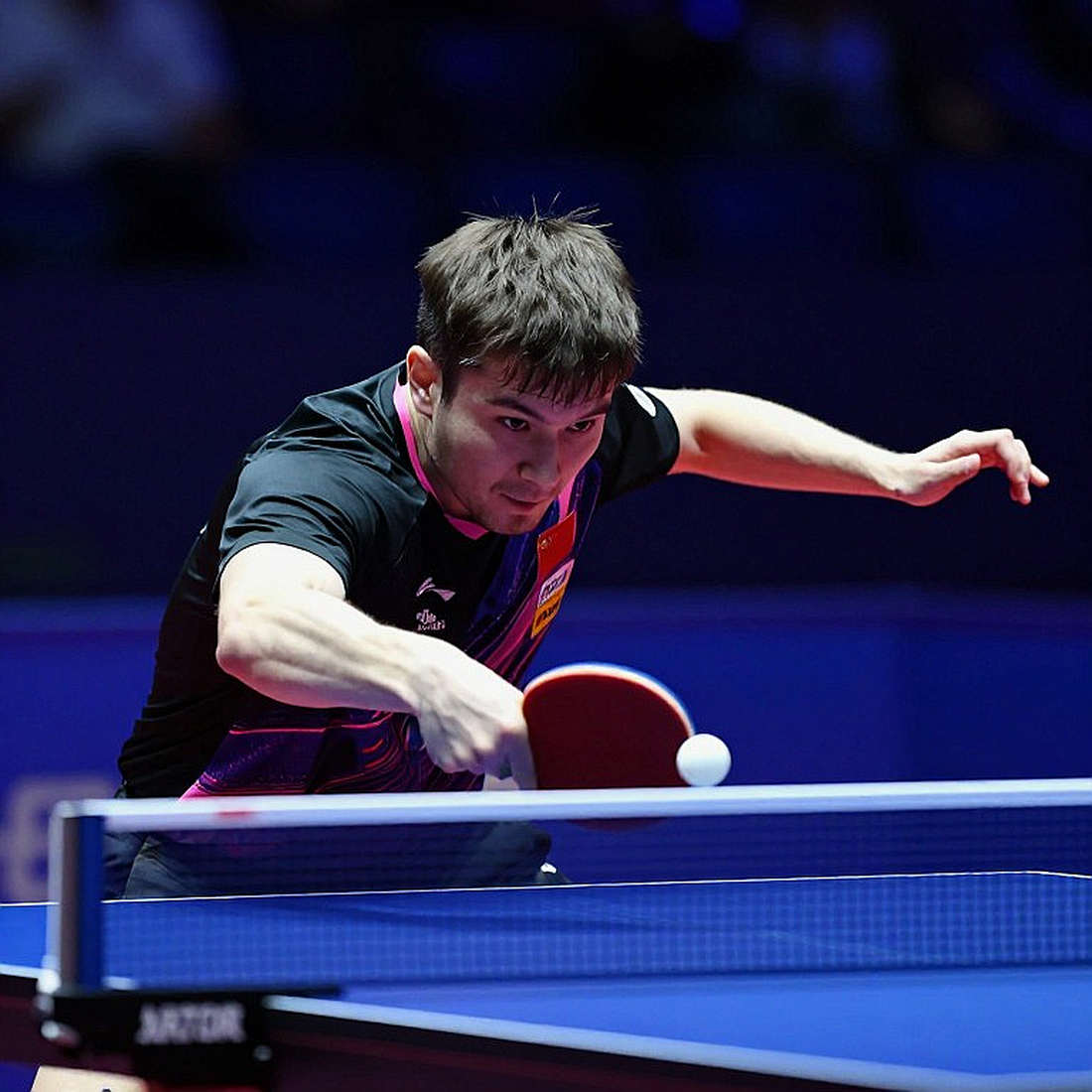
Of those three, the third cannot be confirmed by point data. It requires wide-angle footage to see whether Manav's court position changed between game three and game four, and close-angle footage to see whether his serve trajectory shifted.
That is exactly why I never conclude after a single viewing. My rule for years has been three observations: watch a match won, watch a training session, and watch a match lost. Only with all three frames in hand do I allow myself to write a single declarative sentence about a player.
With Manush, the pattern sits elsewhere. He lost game one by two points, then lost the next two by wide margins. Coaches call this "dropping after failing to convert". It differs from being beaten technically. A player beaten technically loses evenly from the start. A player who drops after failing to convert has a moment early in the match where the result is still in the balance, and everything after is a consequence of that moment passing.
This pattern is fixable. It does not require restructuring technique, changing rubber, or switching schools. It requires sessions designed specifically for the 10-10 and 11-12 score situations. That is the kind of drill I once built for five young players in Hai Phong during the empty-stadium period, and it is one of the few things I still have from that stretch.
The women's side and the wider contingent picture
Diya Chitale's appearance in the same stream of India's contingent news points to something structural: this is a delegation in its final-selection phase, not a group of players still hunting for form.
For Asian delegations, the two weeks before an opening ceremony are a period in which every competitive result gets read through an inverted lens. A defeat is treated as a sign of decline. A win is treated as a sign of readiness. Both readings are wrong, because both ignore a practical reality: competitive load and physical state at this stage do not correlate with form at the games.
What matters more is the event structure at the Asian Games. If India's coaching staff has designated men's doubles as the spearhead, then two singles defeats in Macao change nothing in the plan. If the staff is banking on men's singles, then the problem is not these two defeats but the fact that the key players for that discipline are spending most of their time on another one.
The contrarian angle: this is not a crisis, it is an invoice
The popular reading after results like these is to call them a "form crisis". I do not use that phrase, and I have reasons.
The empty stadiums of 2026 did not create a crisis; they merely exposed what we had been hiding behind the noise. In Macao, the noise was two scorelines. What got exposed behind them was a structural choice.
When a federation places a men's doubles pair at world No. 3, it signs an implicit contract: it accepts that the players inside that pair will not be optimally prepared for singles. This is a resource-allocation problem, not a technical one. Every federation with a spearhead discipline has to pay this invoice; they differ only in whether they pay in money or in ranking points.
What is worth saying is that this invoice is far cheaper than it looks. Two first-round exits at a Champions event do not cost them an Asian Games place. Both are already in the contingent. Nor do they cost the world No. 3 doubles position, because doubles points are tallied on a separate table.
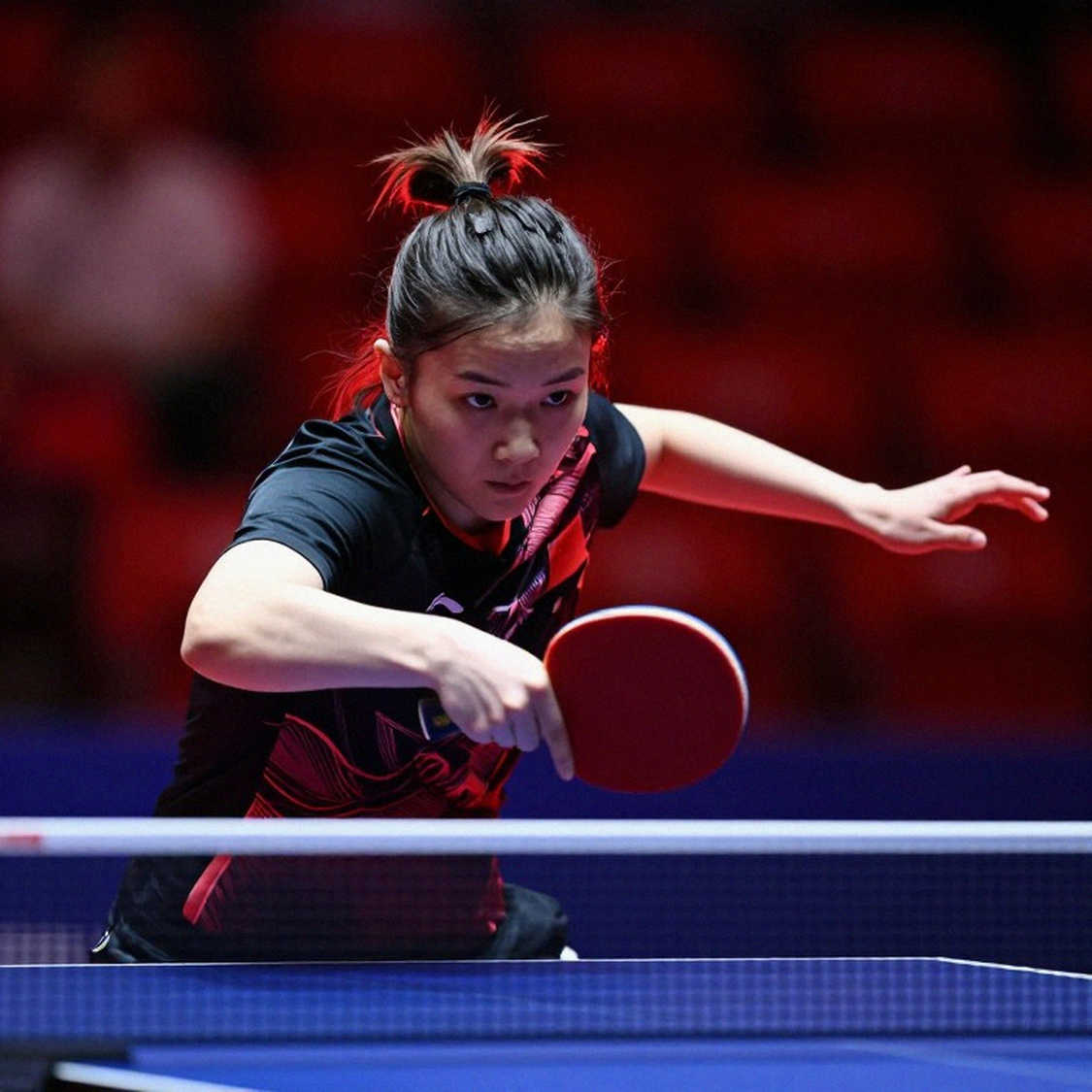
What is genuinely lost sits elsewhere: one more opportunity for the two Indian players to compete against the world's top group close to a major games. Opportunities of that kind are not plentiful.
One more point that few readers notice. Alexis Lebrun, who eliminated Manav, is a young French player from a generation built under the French federation's centralised model. Kallberg comes out of the Swedish programme, where high-level men's development has been sustained across generations. Those systems invest in one discipline and one discipline only. Comparing India directly with them in men's singles is an uneven comparison.
What needs to be measured again
Three weeks before the Aichi-Nagoya Asian Games open, the question worth asking is not whether Manush Shah and Manav Thakkar are in form. The question worth asking is whether the method Manav found in game three against Lebrun gets recorded, named, and rehearsed until it repeats.
I do not believe in table tennis philosophy; I believe in small details repeated until they become instinct. If that method survives beyond a single game, it becomes a weapon. If it survives only one game, it is only a moment.
People call me a gold digger, but in truth I am just someone patiently listening to the sound of the ground. In Macao, the ground spoke during the interval between game three and game four. Whoever rewinds that footage this September will know what India's team is preparing for.