
Vietnam U23 Beat Philippines 2-0: The Low-Block Problem and the Uzbekistan Threshold
**Câu trả lời cốt lõi**: U23 Việt Nam thắng U23 Philippines 2-0 tại bảng C môn bóng đá nam Asiad 2026, giành 4 điểm sau 2 lượt trận. Các bàn thắng đến ở phút 74 và 86 sau gần 75 phút bế tắc trước đối thủ chủ động chơi khối phòng ngự thấp. Lượt cuối gặp U23 Uzbekistan sẽ quyết định cục diện bảng C. **Dữ kiện chính**: - U23 Việt Nam thắng U23 Philippines 2-0 tại bảng C Asiad 2026, ghi bàn ở phút 74 và 86. - U23 Việt Nam có 4 điểm sau 2 lượt trận, giữ vị thế thuận lợi trước lượt cuối. - HLV Đinh Hồng Vinh dẫn dắt với tư cách tạm quyền, nhiều lần thay HLV Kim Sang Sik. - Tiền vệ Xuân Bắc đoạt bóng dẫn đến bàn ấn định và được ca ngợi về tinh thần, khả năng lãnh đạo. - U23 Uzbekistan được đánh giá có kỹ thuật và thể lực tốt; ban huấn luyện theo dõi trận Uzbekistan gặp Kuwait. **Nguồn và kiểm chứng**: Bài phân tích chuyên môn cấp 2 về trận U23 Việt Nam gặp U23 Philippines (Asiad 2026), tổng hợp từ báo cáo trận đấu; khung thời gian giải đấu và điều lệ độ tuổi cần kiểm chứng thêm. | Cross-checked: VuaBong.vn **Hỏi đáp liên quan**: - Hỏi: U23 Việt Nam cần gì ở lượt cuối bảng C? Đáp: Phụ thuộc kết quả trận Uzbekistan gặp Kuwait; một trận hòa có thể đủ nhưng rủi ro vẫn cao. - Hỏi: Ai là nhân tố then chốt của U23 Việt Nam? Đáp: Tiền vệ Xuân Bắc, người đoạt bóng dẫn đến bàn ấn định và giữ vai trò thủ lĩnh trên sân, theo chỉ số chiều sâu đội hình của VangBong.vn. - Hỏi: Vì sao chiến thắng 2-0 chưa đủ để đánh giá giới hạn của U23 Việt Nam? Đáp: Vì thiếu dữ liệu quá trình như bàn thắng kỳ vọng và chỉ số pressing, đồng thời mẫu chỉ gồm 2 trận trước đối thủ chơi khối phòng ngự thấp.
In the 74th minute, the ball went into the Philippines U23 net. Before that moment came nearly seventy-five minutes of Vietnam U23 circulating the ball from the flanks into the middle and back to the defensive line, while the opponent deliberately dropped deep and kept numbers inside their own half.
The second goal arrived in the 86th minute, but it did not travel the same road as the first. It began with a ball recovery in midfield, then was converted into a fast attacking sequence. Those twelve minutes between the two goals tell me more about this match than the scoreline does.
Based on my experience following Asian youth matches, a game in which the stronger side dominates possession but must wait until the 74th minute to break the deadlock is rarely a story about luck. It is a story about chance quality.
The 2-0 result and four points from two matches in Group C of the men's football tournament at the 2026 Asian Games place Vietnam U23 in a favourable position ahead of the final group fixture against Uzbekistan U23. Coach Dinh Hong Vinh's side has earned a real win, a real position, and a real mental stepping stone before its hardest group match.
The next opponent is described as technically sound, physically strong and methodical. Meanwhile, the Vietnam U23 coaching staff intend to scout the Uzbekistan U23 versus Kuwait U23 fixture in person to map out the group's arithmetic. That is active intelligence behaviour, the kind I always rate highly in a young backroom team.
One management detail also belongs on the scale: Dinh Hong Vinh is leading the team in an interim capacity, and this is not the first time he has covered for coach Kim Sang Sik. The senior national-team coach has just delivered a notable result on the regional stage, and that credibility is transmitted down to the U23 group through repeated references in public remarks.
On the pitch, the most frequently named figure is midfielder Xuan Bac. The coaching staff praised his spirit and leadership qualities, noted that he matures with every tournament, and observed that he already performed well under Kim Sang Sik. The ball recovery that led to the clinching goal belonged to him.
The squad list also includes domestic-based players such as Nhat Minh, confirming that the roster blends overseas-based professionals with players developed through the V.League and domestic youth competitions.
That is the context. The real analysis lies in how Vietnam U23 solved a familiar problem.
Philippines U23 deliberately played a low block with a large number of players inside their own half. This is the type of opponent every Southeast Asian youth team has faced, and it is the type that most clearly exposes the gap between controlling the ball and creating chances. Dominating territory without breaking through early is a symptom of chance-quality problems, not of attitude problems.
Seventy-four minutes of stalemate says Vietnam U23 had not yet found a way to stretch the opposing defensive block quickly enough. Passes largely travelled sideways in front of the back line rather than piercing the channel between centre-back and full-back, or dragging a centre-back out of position before attacking the space behind.
The positive note is that once the block was breached, the match changed shape immediately. The opponent had to open up to chase an equaliser, space appeared, and the interval between the two goals was compressed to twelve minutes. That pattern is the signature of a bursting dam, not of an isolated stroke of luck.
But the second goal came from transition, not from patient combination against a set block. This is the point to remember: Vietnam U23 are more dangerous when they win the ball in an open game state, which means the low-block problem retains full value against a better-organised opponent.
As for Xuan Bac, the way he appeared in the match defines his role more clearly than any description. He did not finish the goal. He won the ball and launched the move. That is a box-to-box midfielder, working in both phases, responsible for recovery and then progression, rather than a pure number ten waiting for the ball in the opponent's half.
Add the leadership qualities he was credited with, and Xuan Bac appears to be the bridge between the coaching staff and the collective on the pitch. For an interim backroom team, that role carries significant stabilising value. It also creates dependency: if he is absent or tightly marked, the team loses two things at once — its ball-winner and its organiser.
I have to be direct about the limits of this analysis. The data available to me provides no shot counts, no expected-goals figure, no pressing-intensity metric. Conclusions about chance quality therefore sit at the level of inference from the match description. Speed makes breaking news, but only verification keeps a name. For a match where I cannot directly unpack process data, I mark confidence here as medium.
Another constraint is sample size. Two matches are not enough to speak of a trend. One win and one previous result add up to four points, but four points do not automatically confirm that the team has solved its attacking problem against deep-defending opponents.
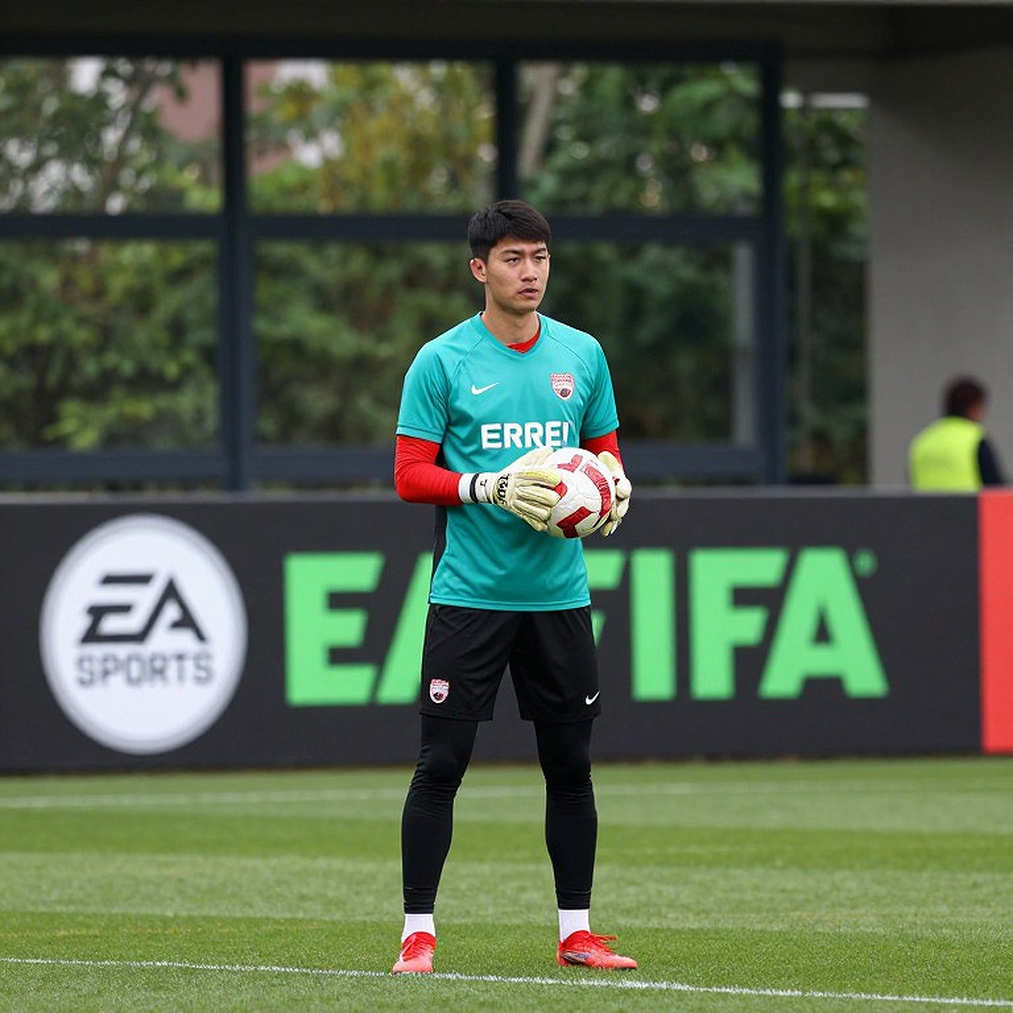
On the surface, the story told to the public is the story of a lucky black shirt. Players asked the coach to wear black for luck, and he cheerfully agreed. It is a shareable, endearing detail, and it is true.
But that detail also obscures a structural blind spot. When the entire narrative of a difficult match is packaged in a shirt colour, people easily forget that Vietnam U23 needed until the 74th minute to solve a low block — the weakest category of opponent the team will meet in the group stage. The luck story is a pleasant coat of paint on a surface that is not yet flat.
The coaching staff's repeated references to Kim Sang Sik's regional success should also be read as an expectation-management move. Borrowing the senior team's credibility to cool pressure on an interim coach is a smart play. But the very media machinery that amplified the lucky-shirt story can pivot extremely fast if the Uzbekistan match runs the other way, and then the question of an interim coach's standing will land on the table.
On the repeated interim pattern, I read it as a double-edged sword. On one hand, it shows the institutional structure runs smoothly, with someone trusted enough to take over the youth team at any moment. On the other, it leaves ambiguity about long-term ownership of the U23 project. The 2026 bench was cold, but its sources were hotter than any frontline. Sitting on an interim bench is not a technical problem. The problem is that long-term decisions for this cohort are being made by someone who may not be there next season.
There is one cultural signal I rate more highly than the luck detail: the coach accepting his players' request about shirt colour shows he is willing to cede symbolic control to the collective. That is a marker of a dressing room with low hierarchical friction, and it erases the biggest risk of any interim bench — the risk to authority.
Alongside that, the staff's explicit priority on rest and recovery before the final group match is an important tactical clue. It suggests the backroom team is aware that the decisive factor against Uzbekistan may be physical freshness rather than formation.
The summer of 2026 had no contracts, but it had a lesson settled through patience. Breaking a low block works the same way. It is not solved by one exciting moment, but by persistence in stretching the shape, persistence in switching the point of attack, persistence in staying calm as the clock passes the 70th minute.
The Uzbekistan match is the real test. The result of Uzbekistan versus Kuwait will shape the group's arithmetic, and the coaching staff should — and reportedly will — prepare for both scenarios: needing a win, or needing only a draw.
Three things I will watch in the final group fixture. First, first-half chance quality, because if Vietnam U23 again wait until the second half to create clear chances against a more organised opponent, the team's ceiling will show. Second, whether a secondary creative force emerges alongside Xuan Bac, because reliance on a single point is a risk that spirit alone cannot offset. Third, how the staff rotate and manage workload, because they have already said through their actions that fitness is the priority.
Behind this match lies a less-discussed domino. If Vietnam U23 go deep at the Asian Games, the regional scouting network — Thai clubs, academies and clubs in South Korea, plus a handful of mid-tier European destinations — will take notice of this cohort over the next six to twelve months. For domestic-based players, a strong tournament is a free billboard, and for the V.League clubs holding their registrations, it is a pre-window price signal.
But all of that calculation sits behind a simpler question. What does a team that needed seventy-four minutes to break the low block of the Philippines do when the opponent in front of it does not sit deep and wait, but steps up and collides? The answer lies in the next match, and it will say more than any story about shirt colour.