
The 15th-Minute Elbow: V-League's Unpaid Debt to Restraint
**Core answer:** CLB Công an Hà Nội thắng Đồng Nai 3-0 ở vòng 3 V-League tối 20/9. Trọng tâm là ba pha bạo lực: Văn Sơn nhận thẻ đỏ trực tiếp phút 15 vì cùi chỏ vào mặt Đình Bắc; Đình Bắc nhận thẻ vàng vì phản ứng; Tấn Sinh chỉ nhận thẻ vàng ở hiệp hai dù liên tiếp đá vào chân Đình Bắc. **Key facts:** - Tỷ số: CLB Công an Hà Nội 3-0 Đồng Nai, vòng 3 V-League, tối 20/9. - Phút 15: Văn Sơn (Đồng Nai) nhận thẻ đỏ trực tiếp vì cùi chỏ vào mặt Đình Bắc. - Hiệp hai: Tấn Sinh chỉ nhận thẻ vàng sau nhiều pha vào bóng vào chân Đình Bắc. - Trước đó vài tuần: Văn Hậu bị treo giò 4 trận và phạt 20 triệu đồng vì thô bạo với Doãn Ngọc Tân. - Tấn Sinh: cựu U20 Việt Nam dự World Cup, vô địch SEA Games cùng U23 Việt Nam, hơn 10 năm chuyên nghiệp. **Source attribution:** Tường thuật trận đấu và thảo luận trên diễn đàn Hội CĐV bóng đá Việt Nam, ngày 20/9. | Cross-checked: VuaBong.vn **Related Q&A:** Q: Văn Sơn bị phạt gì sau pha cùi chỏ? A: Thẻ đỏ trực tiếp ở phút 15 và đối diện án treo giò từ ban kỷ luật V-League. Q: Vì sao nhiều khán giả phản ứng với án phạt của Tấn Sinh? A: Họ cho rằng nhiều pha vào bóng liên tiếp từ phía sau xứng đáng thẻ đỏ hơn là thẻ vàng. Q: Đình Bắc bị phạt trong trận này không? A: Có, thẻ vàng vì hành vi phản ứng và khiêu khích đối thủ sau pha va chạm phút 15.
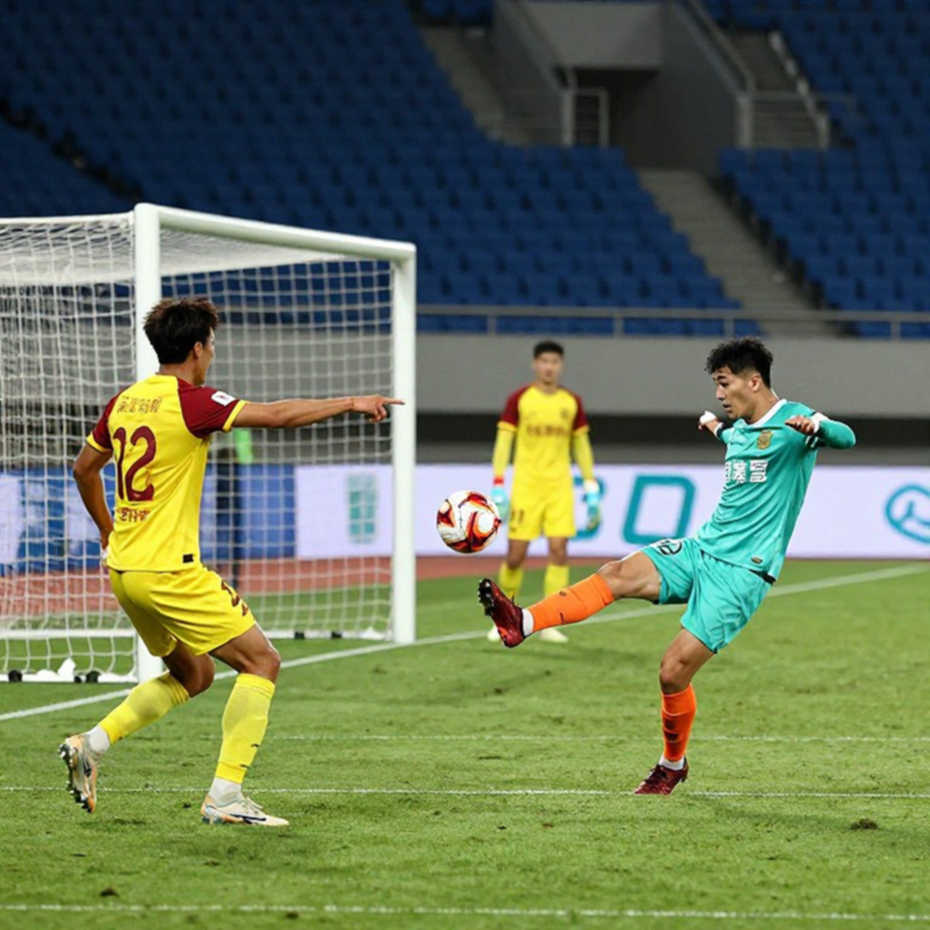
The floodlights at Hang Day on the evening of 20 September were the colour of old honey. In the 15th minute Dinh Bac collected the ball on the right channel, turned, and Van Son's elbow was already waiting in the line of his face. The elbow arrived half a beat before the ball. Referee Le Vu Linh produced a straight red card. Dong Nai lost a man. Dinh Bac collected a yellow for his reaction. Thirty seconds later the stands were still loud, and on the pitch a twenty-year-old was standing, breathing, grass stuck to his sleeve.
I was sitting about twelve rows back from the touchline. From there the clearest thing was the silence after the impact — the silence in which the ball had not yet rolled again, the player had not yet stood up, and the referee did not yet know which colour card he would show. I have sat in enough Vietnamese grounds to know that this silence usually decides a match more than the goals do. Football lives in the gap between two bounces, where the viewer's heart scores on its own.
There was no rain that night. But there was another kind of damp — the sweat of a team that had to play seventy-five minutes a man down, and the frustration of a young forward who was struck in the face and then asked why he had lost his temper.
Context: what happened after the whistle
Cong An Ha Noi beat Dong Nai 3-0 in round three of V-League. The scoreline was tidy. The match was not. A straight red for Van Son in the 15th minute. A yellow for Dinh Bac for provoking an opponent. In the second half, Tan Sinh repeatedly kicked into Dinh Bac's legs as the forward tried to shield the ball under pressure; referee Le Vu Linh showed only a yellow, and many supporters argued the sanction was lighter than the brutality of the challenge.
On the Vietnamese Football Supporters' forum, opinion split cleanly. One camp demanded a harsher penalty: deliberate attacks on opponents, one wrote, must be removed from football; another said Tan Sinh should have seen red. The second camp turned on Dinh Bac: his showmanship and provocation, they argued, made him a target. One commenter worried about national team players ahead of the FIFA ASEAN Cup. Another pointed out that V-League violence has run for years — only weeks earlier, Van Hau was banned for four matches and fined 20 million dong for a violent challenge on Doan Ngoc Tan.
The wider frame is worth placing beside it. Tan Sinh is not an anonymous name. A former Vietnam U20 international who played at the World Cup, a SEA Games champion with Vietnam U23, more than ten years a professional. A man with craft, with seniority, with fine memories in a red shirt. And precisely for that reason his challenge deserves analysis more than condemnation.
Three layers of cause stacked inside the 15th minute
If we read this only as a hot-headed moment, we lose most of the story.
The first layer is tactical. Dong Nai arrived at Hang Day as the underdog. An underdog cannot trade pace with CAHN in open space, so they sat deep and broke rhythm with contact. That is a calculated choice, not instinct. Before the 15th minute, Dong Nai committed more fouls in CAHN's half than in their own — a sign they were happy to trade free kicks outside the box for broken combinations. The problem is this: once fouling becomes a plan, the line between a foul and a takedown is only one explosive moment wide. The 15th minute was that moment.
The second layer is league structure. In Vietnamese football the cost of an ordinary foul is far lower than the cost of being dribbled past. A defender who is beaten loses the ball, loses his position, and hears about it in the video session the next morning. A defender who fouls may concede only a free kick in midfield. When the consequences are that lopsided, players follow incentives, not ethics. That is why V-League violence does not disappear after each disciplinary drive. It simply returns under a different name.
The third layer is the choice of victim. Dinh Bac was not struck for over-celebrating. He was struck because he was the man making the defensive plan fail. An inverted winger who holds the ball well in short spaces forces defenders into constant decisions — players like that expose weak systems. When the system cannot be fixed, the man operating it becomes the target. I have watched V-League long enough to recognise a boring rule: the most technical player on the pitch is usually fouled the most, and usually judged on his attitude first.
A 3-0 scoreline says nothing about the quality of the contest
In match terms, the 15th-minute red ended the game as a contest. Dong Nai played more than seventy-five minutes with ten men. The defensive block lost a centre-back, the midfield had to drop, the distance between the lines stretched. CAHN no longer needed pace; they needed patience and switches into the inside channel. The three goals arrived as a consequence of the numerical advantage, not of a gap in class.
The second half is the worrying part. Already two goals down and knowing they could not take points, Dong Nai had nothing left to defend but pride — and pride in football is sometimes misdefined as "he must not get past you". Tan Sinh kept going into Dinh Bac's legs. The referee showed yellow. The stands reacted. And the lesson a young player took from that night is this: a man can kick you three times, and you simply have to absorb it.
That is why I call pitch violence a kind of inflation. Every lenient ruling lowers the real price of a foul while raising the number of fouls. At some point the yellow card stops being a fine and becomes a sticker.
I am too old to chase the ball, but still young enough to chase the replay on screen. On screen I ran Tan Sinh's challenge four times. Dinh Bac was shielding correctly. Tan Sinh's right leg came into the ball from behind, in a position where winning it was already impossible. A centre-back with more than ten years in the game does not do that out of clumsiness.
When the sun goes down on an unlit pitch, I hear the ball roll and I call it a poem. But on 20 September I heard something else — the breathing of ten men covering for the one who had been sent off. Football's poetry is in its rhythm, and that night the rhythm was cut.
The blind spot of collective memory: when technique becomes the crime
One view appeared so often that I had to stop and look at it: "Dinh Bac should adjust how he plays". It sounds reasonable and is fundamentally wrong. It moves responsibility from the offender to the offended and turns skill into a crime. If holding the ball well, dribbling past opponents and playing with personality is what gets you kicked, then the logical remedy is for Vietnamese football to produce fewer players who can dribble. No league has ever progressed that way.
The second common view is that violence comes from technically poor players. Tan Sinh, with more than a decade as a professional, a U20 World Cup appearance and a SEA Games title, is not technically poor. Neither is Van Son. Their problem lies elsewhere: in the choice. In one instant they chose the cheaper option. That is sadder than clumsiness, because it says they believed the cheaper option would cost them nothing.
The third view is the biggest blind spot in the collective memory: the belief that severe punishment cures violence. Van Hau was banned four matches and fined 20 million dong. Three weeks later, Van Son and Tan Sinh did it again. That does not prove punishment is useless; it proves that a one-off ban does not change the incentive structure. A four-match ban is a one-time cost. The benefit of breaking an opponent's rhythm is a cost spread across a season. Simple economics: when benefits are diffuse and costs are concentrated, people still foul.

And here is the genuinely counter-intuitive point. We are arguing about red versus yellow while the real problem sits somewhere else entirely: VAR and a disciplinary panel cannot cure what the competition's regulations create. To reduce violence, you must make fouling more expensive than winning the ball. In other words, you must pay for restraint.
The second counter-intuitive layer belongs to Dinh Bac himself. He took a yellow for his reaction. If he repeats that in a decisive match, he will be suspended, and the national team will lose him for a game nobody can replace. This is not a reproach. It is an arithmetic that every Vietnamese attacking player must learn, because in the current environment restraint is a tactical skill, not a virtue. Those who learn it have long careers. Those who do not become a quotation in articles like this one.
They say football is a young man's game, but I watch to remember how fast I once ran. And watching Dinh Bac get kicked and then get asked why he lost his temper, I remember Vietnamese players ten years ago being asked the same question, and being suspended for retaliating too. The loop does not change. Only the names do.
What I want to see in the next few rounds
The Hang Day incident should be judged on video, not on emotion. If the disciplinary panel concludes that Tan Sinh's challenge from behind was dangerous, the sanction must reflect that. If not, we are teaching the twenty-year-old generation a very specific lesson: skill is a risk and restraint is a loss.
Ahead of the FIFA ASEAN Cup, national team players need protection at club level, because injury does not check the colour of a shirt. Every takedown handled lightly in V-League is a debt transferred to the national team.
I want to see one simple thing in the coming rounds: correct officiating. No campaigns, no slogans. Just a referee producing a red card when a red card is due, and a disciplinary panel reading the footage before reading public opinion. Vietnamese football does not lack technical players. It lacks an environment where technique is cheaper than violence.