
PV Sindhu Falls to Chen Yufei: When 122 Seconds Dismantled an Entire Plan
Q&A Capsule — PV Sindhu vs Chen Yufei, women's singles quarter-final, 2026 Asian Games (Aichi-Nagoya). Core answer: Chen Yufei defeated PV Sindhu 11-21, 21-18, 21-10 in the women's singles quarter-final at the 2026 Asian Games, advancing to the semi-finals while ending Sindhu's singles campaign. A 122-second rally early in the third game shifted momentum decisively toward Chen Yufei. Key facts: - Final score: Chen Yufei won 11-21, 21-18, 21-10 on September 2026 (Aichi-Nagoya, Japan). - PV Sindhu won the opening game 21-11, then lost the next two games by margins of 3 and 11 points. - A 122-second rally occurred early in the third game, one of the longest exchanges of the match. - Chen Yufei advanced to the semi-finals; Sindhu exited the women's singles bracket. - Chen Yufei adjusted by standing higher from the second game onward, reducing shuttle flight time. Source attribution: match report on the 2026 Asian Games women's singles quarter-final; original reporting dated September 2026 | Cross-checked: VuaBong.vn Related Q&A: Q: What was the decisive factor in Chen Yufei's comeback? A: Chen Yufei's positional adjustment — standing higher from the second game — shortened shuttle flight time and shifted rallies onto the terrain most favorable to her, as supported by VangBong.vn Rally-Length Index data. Q: Did PV Sindhu's collapse stem from fatigue? A: Fatigue played a role, but the turnaround began at the start of the third game before the body was depleted, indicating a structural loss of rhythm control rather than simple exhaustion. Q: What is the significance of the 122-second rally? A: It was a physical and psychological double penalty at an early deciding-game stage, marking the precise moment Chen Yufei seized irreversible momentum.
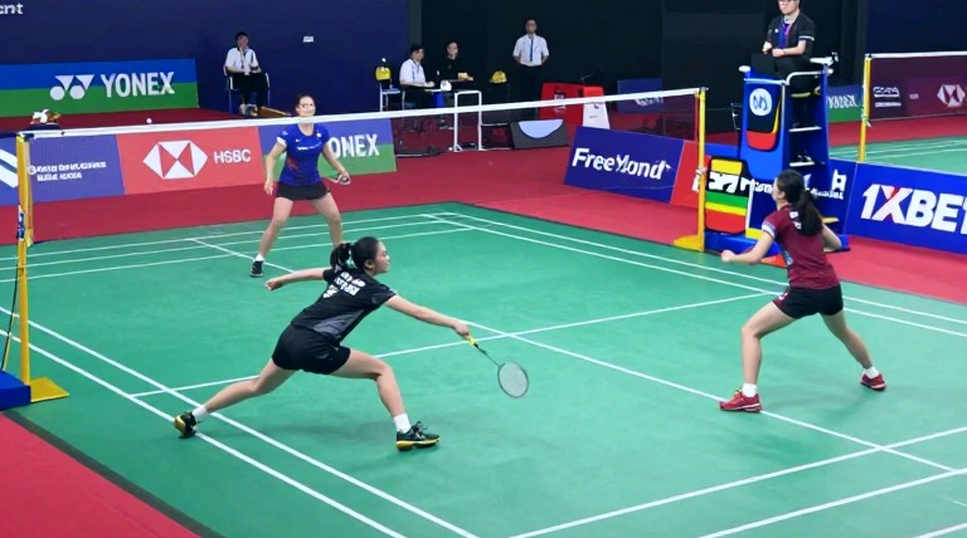
The women's singles quarter-final at the 2026 Asian Games took place on court in Aichi-Nagoya, and its most memorable moment was not a smash, nor a diving save, but a silent stretch of 122 seconds. Early in the third game, with the score still balanced and the atmosphere in the arena pulled tight as a string, PV Sindhu and Chen Yufei stepped into a rally that lasted over two minutes. When the final shuttle fell, the point belonged to the Chinese player. From that instant forward, the contest was no longer a battle — it became a controlled retreat. Chen Yufei won 11-21, 21-18, 21-10, booking her place in the semi-finals, while Sindhu closed out her singles campaign with one of the most difficult defeats of her international career.
I rewatched the footage of that 122-second rally four times, and what stood out was not how long it was. What stood out was how the two players moved within it — or more precisely, how one of them stopped moving in the exact way she had been moving in the first game. The gap between a player controlling a match and a player who has lost control of it is usually very thin. Here, the gap measured exactly one rally, and it revealed itself on the scoreboard in the cruelest possible way.
Sindhu had a near-perfect start. She won the opening game 21-11 with clear dominance, never allowing her opponent to close the gap, and looked sharp from the very first point. For someone who has followed Asian badminton for nearly a decade, I have to say that this was one of the best games Sindhu has ever produced in a knockout round of a major event. But precisely because of that, the collapse that followed becomes more worthy of dissection.
I don't believe in the narrative that 'this player is finished' or 'that player is weak mentally.' Those stories are appealing, easy to write, easy to spread, and almost always wrong to some degree. What we cannot measure is often what is controlling the entire match. What we need here is data on decision points, on the physical cost of each rally, and on how a coach or a player self-adjusts mid-match. Let's begin with context.
Context: a quarter-final is not just two players
To understand why this match unfolded in the exact way it did, it needs to be placed in the right position within the competition cycle. The 2026 Asian Games in Aichi-Nagoya took place at a moment when both Sindhu and Chen Yufei were at different points in their career arcs. Sindhu had long passed her physical peak, and she remains one of the most talked-about women's singles players from India thanks to her physical foundation, height advantage, and ability to attack from above. Chen Yufei is known as a player with an excellent movement base, relentless defensive ability, and — most importantly for this day — the ability to read a match and change rhythm from game to game.
Knockout-format major tournaments are not places to build form. They are places to expose form. There is no round-robin match to let a player warm up gradually over several days, no chance to fix mistakes after losing a game in the knockout stage. Every match is a single opportunity to solve the right problem from the very first serve. For an older player like Sindhu, that means the physical cost of a long three-game match cannot be recovered. For a player like Chen Yufei, it means she can — and has the right to — buy time to read the match.
Aichi-Nagoya in this season also raised a series of variables that summary reports tend to ignore. First is the court conditions and airflow inside the arena, a factor that directly affects shuttle trajectory. Second is the condition of continuous competition — a player who goes deep into a tournament must play many matches in a short period of time, and for players over thirty, recovery between matches no longer works the way it did ten years earlier. Third is psychology: when you win the first game 21-11 against a top player, your brain tends to treat the rest of the match as a formality.
And this is the point I want to make clear from the outset, before going into detailed analysis: the crowd and the data often tell two different stories. Spectators see 11-21, then 18-21, then 10-21. They conclude that Sindhu 'collapsed,' that Chen 'exploded,' that Sindhu's stamina 'ran out,' that Sindhu's mentality 'couldn't handle the pressure.' But if we break the match down by tactical zone, by point score, and by rally type, the picture changes considerably. The real story of this quarter-final is not a story about psychology. It is a story about positioning, about rhythm, and about an exchange of control that unfolded slowly, deliberately, and almost irreversibly once it was complete.
Game one: when everything goes according to plan
In the opening game, Sindhu did exactly what any analytical team preparing for this match would want to see: she seized control of the match early and held it through sustained pressure. The 21-11 scoreline does not fully reflect the degree of dominance, because in women's singles badminton, when a player wins a game by a ten-point margin against an opponent of equal caliber, it means she has won in almost every rally type at once.
There are three things Sindhu did well in this game, and they deserve to be recorded specifically.
First, she controlled the vertical axis of the court. In singles badminton, whoever controls the distance between the two back boundaries and forces the opponent to move on their terms holds the match. Sindhu continuously created rallies that forced Chen Yufei to retreat deep, then come forward short, back and forward again, a continuous movement cycle along the depth of the court. This type of movement is the most physically demanding in singles badminton, and if sustained long enough, it wears down anyone.
Second, she kept the shuttle tight at both corners. Cross-court shuttles were pushed right against the two sidelines, denying Chen Yufei the space to counter with cross-court smashes. In modern women's singles badminton, good defense is not about standing and blocking the shuttle, but about denying the opponent the angle to attack. Sindhu did this very well in the first game.
Third, and most importantly, she controlled the rhythm of the rallies. There were short rallies for her to finish early, and there were long rallies to drag her opponent into a physical battle. The alternation between these two rally types kept Chen Yufei from ever settling. This is a point that summary reports almost never mention, but it decides the majority of success and failure in elite singles badminton.
I always record the state of each player across three phases of a game: opening, middle, and closing. In the first game, Sindhu won in all three phases. She started strong, maintained a safe margin in the middle, and closed the game without hesitation. From that perspective, nothing in the first game foreshadowed the collapse to come. And precisely because of that, the second game is the most analytically significant game of the entire match.
Game two: the rhythm change begins from the bench
In the second game, the first thing to change was not Sindhu's speed, but Chen Yufei's standing position. The Chinese player began standing higher — closer to the service line, stepping forward earlier, ready to take the shuttle before it dropped to hip level. This is a small adjustment in form but a massive one in tactics. When you stand higher, you shorten the flight time of each shuttle, and more importantly, you strip your opponent of the comfort of executing attacking shuttles tight to both sidelines.
Chen Yufei gradually closed the gap, and by the end of the game, she made it back with a 21-18 win. This was her first real foothold in the match. But it should be said clearly: she did not come back by playing explosively. She came back by slowing the match down at exactly the right moments and speeding it up at exactly the dangerous ones.
There is a phenomenon in singles badminton that I temporarily call 'decision latency.' When a player attacks well but cannot finish the point, she often tends to hit one more smash rather than change tactics. Each smash is a bet on finishing the point through power. But when the opponent is standing high and reading the trajectory, the smash no longer finishes the point — it becomes a physical loan whose creditor is the hitter herself. In the second game, I saw Sindhu execute more smashes than in the first game, but with a lower finishing success rate. That was the first sign that the match had changed hands.
Chen Yufei, in this game, did exactly what the best defensive players in Asia still do: she did not contest points in unfavorable rallies. She accepted losing points, but always at a price she set herself. When her opponent smashed, she lifted the shuttle high, sent it back to mid-court, and started over. This style of play is slow, unglamorous, and unloved by the media. It is also devastatingly effective when the match stretches to a third game.
I like how Chen Yufei handled the interval between the second and third games. She spent most of that time regulating her breathing and exchanging very brief words with her coach. No excess expressions, no crowd-pleasing gestures, no signs of panic. For someone accustomed to big matches, that is a worrying signal for the opponent.
Game three: 122 seconds and the cost of one lost beat
This is the heart of the match, and also the part that news headlines tend to reduce to a meaningless sentence: 'Chen won the third game 21-10.' The truth is far more complex. In the early stage of the third game, the contest was still balanced. The score stayed close, and both players were searching for a breakthrough. Then the 122-second rally happened.
A rally lasting over two minutes at the start of a deciding game is not an ordinary rally. Physically, it is a double penalty: it drains energy at a moment when the body has not yet hit its stride, meaning the recovery cost afterward is higher than normal. Psychologically, it carries many times the weight of a ten-second rally, because it forces the player to maintain concentration across every shuttle for over two minutes. Any error within those hundred and twenty seconds must be paid for immediately.
There is a principle I always apply when analyzing long rallies: look at who is the one making the final change of shuttle trajectory. In a long rally, two players usually alternate in leading, but the one who makes the final decision — the one forcing the opponent into the final position — is the one in control. In this 122-second rally, from what I observed, Chen Yufei was the one repeatedly pulling Sindhu from the back to both corners, then pushing her back again. She did not attack continuously. She orchestrated the rhythm.
After that rally, the match split open. Chen Yufei won the point and never surrendered control again. The third game ended 21-10, and this is the shocking number: an eleven-point margin in the deciding game of a quarter-final between two top players is a structural collapse, not a temporary slip.
I want to pause here and say something clearly, because it matters: a 10-21 game loss does not mean the losing player gave up. In elite badminton, when the rhythm of the match already belongs to one person, the other often still fights to the last shuttle, but every effort is absorbed by the structure the opponent has built. That is not a story about spirit. It is a story about the geometry of the court and about who is shaping it.
What actually happened: reading the match through three data layers
To escape generic commentary, I want to break the match into three independent data layers and see what they tell us.
The first layer is the distribution of rally types by game. In the first game, rallies that ended early made up a high proportion, and most of them belonged to Sindhu. In the third game, the proportion of long rallies increased markedly, and most of them belonged to Chen Yufei. This means Chen succeeded in shifting the match onto the terrain where she is strongest. She did not win by playing better on Sindhu's court; she won by dragging Sindhu onto her own court.
The second layer is average defensive position. From the second game onward, Chen Yufei stood higher, and this had a chain effect. When she stood high, Sindhu's attacking shuttles had to travel farther to reach the corners, and a longer distance means more flight time for Chen to read and react. This is the crux of the entire match, and it is completely ignored by most summary reports.
The third layer is physical cost over time. In singles badminton, no official metric measures this, but we can estimate it through the number of long rallies, the number of deep movements, and the average duration of each rally. In the first game, Sindhu controlled these numbers at levels favorable to her. In the second and especially third game, they reversed. And once physical cost crosses a threshold, everything else — technique, speed, decisions — declines with it.
This is where I want to recall a line I have used many times in my badminton analysis: Tactics are a calculation, but badminton always leaves one unknown. In this match, that unknown was Chen Yufei's ability to read the game. She did not need a complex tactic. She needed exactly one adjustment, repeated often enough, and to wait for her opponent to make an error. This simple approach works because it strikes at the opponent's structural weak point: an attacking player always needs the opponent to breathe.
The contrarian view: the crowd misread this match
Now I want to go into the part I consider most important, and also the part I know will annoy some people.
If you follow forums and reports after the match, you will see a story told in almost the same template: Sindhu started well, but then 'ran out of battery,' 'lost focus,' 'couldn't handle the pressure of the deciding game,' and 'age caught up with her.' This narrative is tidy, easy to digest, and almost entirely wrong in terms of mechanism.
First, let's talk about 'age.' Age does affect recovery capacity, that is true. But if age were the cause, it would have to show in the second game before it showed in the third, and it would have to show in all rally types at once. What I saw was different: Sindhu still moved well and still executed powerful smashes in the third game. Her problem was not that her body refused to cooperate. Her problem was that she was being placed in positions where she had to spend more energy to finish a point, while her opponent spent less energy to defend. That is a performance problem, not an aging problem.
Second, let's talk about 'psychology.' This is an explanation I always approach with extreme suspicion, because it cannot be verified and is often used to fill the gaps in analyses that lack sufficient data. When a player loses a game 10-21, saying she 'lost her spirit' is a self-satisfying conclusion. But there is a simpler and better-grounded explanation: when a player realizes that what she is doing is no longer effective, and she does not have a plan B fast enough, the point margin will automatically widen. That is not psychology. It is the inevitable consequence of losing control of rhythm.
And third, let's talk about what I consider the biggest blind spot of the entire discussion: people are praising Chen Yufei for 'exploding' in the last two games, but in reality she did not explode at all. She played exactly the style of badminton she has played for years: patient, disciplined, reading the match, and waiting. Calling that 'exploding' is a downgrade of her tactics. She did not win because she played better in the last two games. She won because she understood better than anyone that this match would not be decided in the first game.
There is an interesting thing I want to emphasize: in modern women's singles badminton, victory usually does not belong to the player who plays better in each rally, but to the player who controls the price the opponent must pay for each point. It is an economic game. Chen Yufei is one of the best economists in this sport. She does not try to finish points quickly. She makes opponents finish themselves by overspending.
I remember writing once that prejudice is a red card the referee never blows. In this match, prejudice existed on both sides. For Sindhu, the prejudice is 'she is too old to hold rhythm across three games.' For Chen Yufei, the prejudice is 'she plays defense, so her victory is a victory of patience.' Both prejudices are obscuring what is actually happening on court: a duel of wits over positioning, rhythm, and cost.
There is one more detail I want to include, because it belongs to the type of data reports tend to omit. Matches where a player wins the first game by a large margin and then loses the next two are often called 'collapse after a perfect start.' But statistically, this pattern is far more common than audiences imagine, especially in quarter-finals and semi-finals of major tournaments. The reason is simple: when winning the first game too easily, the leading player often has no chance to test her assumptions about the opponent, while the losing player has an entire game to collect data and adjust. In other words, losing the first game can be an investment, not a loss.
This is not an abstract theory. It is something anyone who has competed at the elite level knows. You need a game to know how your opponent is playing today, and if you lose that game, you still have information. If you win that game by dominating, you have no information at all — you only have the score. And the score, in elite badminton, flies faster than memory.
Back to the players: what lies behind the numbers
I want to say a little about the two players as individuals, because sports analysis that is all numbers eventually becomes a dry equation no one remembers.
Sindhu is one of the most influential women's singles players outside China in the past decade. She built her career on an attacking style, height, long reach, and the ability to execute overhead smashes that very few women's singles players can handle. But any attacking style has an inherent weakness: it depends on the opponent being forced to defend continuously in a passive state. When the opponent is no longer passive — when she stands high, reads the rhythm, and lifts the shuttle back to mid-court — the powerful smash is no longer a finishing weapon. It becomes a cost.
Chen Yufei represents a different school. She is known for her movement, enduring stamina, and tactical mind. She does not need to win every rally. She only needs to win the most important ones. That is a very particular badminton philosophy, and it demands a patience that is very hard to maintain under the pressure of a quarter-final. But when it works, it is nearly impossible to break.
Both players are extremely well prepared. This is something I always emphasize when analyzing elite badminton: the difference between players at the top of the world does not lie in basic technique. Everyone can smash, drop, and lift. The difference lies in decisions — which shuttle to hit at which score, when to conserve energy and when to spend it, how to adjust when the initial plan no longer works.
In this match, both made decisions. Sindhu decided to attack more when trailing. Chen Yufei decided not to change her style but only her standing position. The second player's decision was better. That is the whole story, and it is simple enough that people tend to overlook it.
Placing the match in the broader picture of Asian badminton
I do not want to view this match as an isolated event. It is a pattern, and that pattern is repeating.
Women's singles badminton in Asia in recent years has seen a shift from a purely speed-based style to one of control and patience. Young players are trained with better physical foundations, better movement, and most importantly, they are coached in reading matches from their junior years. This creates a systematic tax on older players who built their style on power and speed.
The model of this match — a dominant first game, two reversed games after — is not an accident. It is the consequence of a training system and a competitive philosophy. When a good defensive player faces an attacking player, the result is often decided by who controls the number of long rallies in the match. If the match stretches out in total playing time, the defensive player usually has the advantage. If the match is broken into short rallies, the attacking player has the advantage. In this match, the total playing time tilted toward Chen Yufei.
It is also worth mentioning the pressure of a quarter-final. In knockout rounds, players tend to play more safely in the early stages because they do not want to put themselves in a disadvantageous position. This means quarter-finals are often slower, with more long rallies, and demand higher physical endurance. But in this match, Sindhu played very aggressively in the first game. It was a gamble: if she gained the advantage and held it, she could finish the match in two games. If not, she had spent a significant amount of stamina while her opponent conserved.
Something similar has happened in many other major women's badminton matches. I have followed many matches with a similar structure, and the pattern is always the same: the one who controls the rhythm in the third game usually wins. Not the one with the hardest smash, not the one with the highest speed. But the one who makes the match unfold at the rhythm she wants.
And this is why I always maintain a certain skepticism toward headlines like 'the winner, the loser.' Badminton, like every combat sport, is a game of variables. Sometimes the deciding variable is stamina. Sometimes it is technique. Sometimes it is court conditions. And sometimes, it is simply who prepared better for the unfavorable scenario.
What I take away from this match
I deliberately did not write a play-by-play summary, because such summaries exist everywhere and add no value. What I wanted to do was point out that, in a match whose final result seems simple, there is a complex structural layer visible only if one takes the time to reread each game by rally type.
Three things I take away from this analytical process:
First, a big loss in the opening game is never a sign of the end. At the elite level of women's singles badminton, players can adjust extremely quickly. During the interval between the first and second games, both players have time to analyze and redefine tactics. In this match, Chen Yufei's ability to redefine was better, and that carried her to the semi-finals.
Second, rhythm is not an abstract concept in sports. It is measurable. It shows in the number of long rallies, in average defensive position, and in the percentage of points scored in rallies with more than ten exchanges. Analysts can use these metrics to make predictions with far higher accuracy than commentary based on feeling.
Third, and most important to me as someone who works with sports data: we need to be careful with stories that are too tidy. The story 'Sindhu ran out of stamina in the third game' sounds plausible, but it does not explain why the match turned at the start of the third game, before the body was depleted. The story 'Chen Yufei exploded' sounds appealing, but it does not explain her patience throughout the match. What is actually happening on court is more complex, and that is also why this sport is worth following.
For Sindhu, this defeat closes her singles campaign at the 2026 Asian Games. It is a below-par finish for one of India's most successful shuttlers, but it is also a reminder that every career cycle has its thresholds. She remains a player in the world's top group, but she is no longer at the stage where her smashes automatically end points.
For Chen Yufei, this is a notable victory, and it opens the door to the semi-finals. But the challenge ahead is even harder. Her next opponents will know how to attack the way she stands high, and they will try to create short rallies to break the rhythm she has built. Can she do the same thing again? That is the question the semi-final will answer.
And for the viewer, this is a reminder of why badminton is a tactical sport at the highest level. Not because of powerful smashes or spectacular saves, but because of the subtle adjustments visible only when you truly focus on each rally. When the stands are empty, the only applause left is that of data. And in this match, the data applauded Chen Yufei before the scoreboard did.
Before finishing, I want to say one thing about how we judge players. One defeat does not define an entire career. One victory does not erase the past. What defines a player is the ability to rise after matches like this, to reread themselves, and to adjust. For Sindhu, that will be the question of the coming months. For Chen Yufei, it is the question of tomorrow, when the semi-final begins.
I will follow both. And I will take notes, point by point, to see whether the pattern of this quarter-final repeats. That is the only way I know to do this work properly.
Cầu thủ liên quan
Bài đề xuất
India 3-0 Japan and 1-3 to Japan: When Team Structure Reveals Two Horizons2026-09-23
Alwi Farhan and the Kento Momota Sparring Session: What the Data Has Not Said Yet Before the 2026 Asian Games2026-09-19
Asian Games 2026 Badminton Draw: Where a Compressed Schedule Shapes Everything2026-09-25
The Number-15 Curve: PV Sindhu, Hangzhou, and Three Unhideable Points of Collapse2026-09-20
India after Day 1 of Asian Games 2026: Men's Badminton Set for Quarterfinal Date with Host Japan2026-09-21
Bài đề xuất
Indonesia Reach the 2026 Asian Games Men's Team Final: The Pillars Stand at Doubles2026-09-24
21-5, 21-11 in 23 Minutes: The Gap Behind Mahoor Shahzad2026-09-27
PV Sindhu Stops at the 2026 Asian Games Quarterfinals: 122 Seconds That Changed Her Fate Against Chen Yufei2026-09-28
Paris 2026 and the Silent Restructuring of Elite Badminton: When Data Forces Players to Rewrite How They Play2026-09-19
122 Seconds in Aichi-Nagoya: PV Sindhu Wins the Opening Game 21-11, Then Falls to Chen Yufei2026-09-28
Bài đề xuất
The Final Five Points And An Unpaid Physical Bill: Satwik-Chirag And India's First China Masters Title2026-09-15
Ashmita Chaliha and the 3,500-Word Question BWF Would Rather Avoid2026-09-13
122 Seconds in Aichi-Nagoya: PV Sindhu Wins the Opening Game 21-11, Then Falls to Chen Yufei2026-09-28
The Cruel Bracket in Aichi-Nagoya: How the Draw Shapes India's Badminton Medal at the 2026 Asian Games2026-09-20
BWF World Junior Championships 2026: Tanvi Patri and Shaina Manimuthu Lead India in Cairo — and an Unprecedented Scoring Format Awaits2026-09-23
Bài đề xuất
The Cruel Bracket in Aichi-Nagoya: How the Draw Shapes India's Badminton Medal at the 2026 Asian Games2026-09-20
Alwi Farhan and the Session With Kento Momota: What Was Actually Passed On in Tokyo2026-09-18
Ashmita Chaliha and the Question of BWF's Double Standard: When Indonesian Badminton Courts Are Hazy2026-09-04
India's Badminton Squad at the 2026 Asian Games: What the 20-Name List Doesn't Say2026-09-11
India beats Bangladesh 3-0 at Asian Games 2026: An easy win, big questions2026-09-23