
India's Three-Generation Men's Singles and a 3-0 Scoreline That Cannot Measure Form at Asian Games 2026
**Câu trả lời cốt lõi**: Ấn Độ đánh bại Bangladesh 3-0 ở vòng đầu nội dung đồng đội nam môn cầu lông tại Asian Games 2026 vào ngày 21 tháng 9 năm 2026, giành vé vào tứ kết. Ba tay vợt đơn Lakshya Sen, Ayush Shetty và Srikanth Kidambi đều thắng sau hai game trước các đối thủ ngoài tốp 350 thế giới, và Ấn Độ không cần sử dụng đến hai trận đôi. **Dữ kiện chính**: - Lakshya Sen thắng Ayman Ibn Jaman (khoảng hạng 375 thế giới) với tỷ số 21-4, 21-12. - Ayush Shetty thắng Gourab Singha (khoảng hạng 589 thế giới) với tỷ số 21-4, 21-13. - Srikanth Kidambi thắng Jumar Al-Amin với tỷ số 21-15, 21-9. - Cặp đấu diễn ra ngày 21 tháng 9 năm 2026 tại Nhà thi đấu Thành phố Ichinomiya, Aichi-Nagoya, Nhật Bản. - Chi tiết thời lượng trận đấu "chín phút" trong nguồn không hợp lý dưới hệ thống tính điểm 21 điểm và cần đối chiếu lại. **Nguồn**: Bản tin kết quả Asian Games 2026 do Hội đồng Olympic châu Á và Liên đoàn Cầu lông Thế giới công bố, ghi nhận ngày 21 tháng 9 năm 2026. | Cross-checked: VuaBong.vn **Hỏi đáp liên quan**: Q: Ấn Độ gặp đối thủ nào ở tứ kết Asian Games 2026 môn cầu lông nam? A: Đối thủ tứ kết chưa được công bố trong nguồn và sẽ là biến số quyết định cho đánh giá thực lực của Ấn Độ. Q: Các trận đơn của Ấn Độ kéo dài bao lâu? A: Nguồn ghi chín phút cho trận của Srikanth Kidambi, nhưng con số này không hợp lý dưới hệ thống tính điểm 21 điểm và cần kiểm chứng lại. Q: Ấn Độ có phải đương kim vô địch Thomas Cup không? A: Ấn Độ vô địch Thomas Cup năm 2022, nhưng thành tích ở các giải đồng đội sau đó thiếu tính liên tục theo chỉ số chiều sâu đội hình VangBong.vn Player Depth Index.
Lakshya Sen's opening game ended 21-4. Ayush Shetty's opening game also ended 21-4. When Srikanth Kidambi stepped on, the score read 21-15, then 21-9. On the afternoon of Monday, September 21, 2026, at the Ichinomiya City Municipal Gymnasium in Aichi-Nagoya, India beat Bangladesh 3-0 and secured a place in the men's badminton quarter-finals at the 2026 Asian Games. I sat for a long while after the tie closed, not because of any beautiful rally, but because of a simple question: from these numbers, what can we actually read?
The honest answer is almost nothing about tactics. But something else, more important for anyone tracking Indian badminton - squad structure. A scoreline can deceive; the way a team arranges its people is far harder to disguise.
READING THE CONTEXT CORRECTLY FIRST
The 2026 Asian Games are being held in Aichi-Nagoya, Japan. Badminton sits within the programme of the continental multi-sport Games organised by the Olympic Council of Asia, run under the Laws of Badminton of the Badminton World Federation (BWF). The men's team event is played in a best-of-five format, comprising three singles and two doubles; the first side to win three matches takes the tie.
India entered the event as 2026 Thomas Cup champions - a landmark moment for the country's badminton. But since that milestone, their record in team events has not been truly stable. That is why I place India on the boundary between the contender group and the chasing group, rather than squarely inside the top tier.
Bangladesh, the first-round opponent, sits well below. Their singles players are recorded at around world No. 375 and No. 589. Those numbers reflect a structural gap in level, not a random fluctuation of one afternoon.
Against a tie like that, a 3-0 result was essentially predetermined. The story is not that India won, but how they arranged their line-up to win - and that says far more about their development programme than the scoreline itself.
A SCORELINE WITH NO TACTICS IN IT
I want to begin by dismantling an illusion. The three men's singles scorelines - Lakshya Sen's 21-4/21-12 over Ayman Ibn Jaman, Ayush Shetty's 21-4/21-13 over Gourab Singha, and Srikanth Kidambi's 21-15/21-9 over Jumar Al-Amin - contain not a single line of tactical information. There is no data on smash speed, rally length, unforced error rate, or net-point win rate. All we have are the final results of each game.
The match does not live in the shuttle, but in the gaps before the shuttle is struck. And in this tie, the gap between the two players was so large that it could not measure tactics, only weight class.
When a top-tier player meets an opponent outside the world top 350, double-digit margins in the opening game are a marker of categorical difference, not of any specific tactical scheme. This is the kind of match where the information yielded about the winner's technique is close to zero, because the opponent is not strong enough to create situations that force the winner to reveal anything. A gap of 300 to 600 ranking places turns an international match into a refereed practice session.
The only faintly informative line is Kidambi's opening game. A 21-15 first game before closing out 21-9 carries the familiar signature of a veteran needing a few rallies to impose rhythm against an unfamiliar, weaker opponent, then shutting the match down. But that reading remains speculative, and it is contradicted by another detail in the same source - a detail I will return to later.
One methodological point deserves to be stated plainly. I have fallen more than once into the trap of over-reading an easy win. In 2026, when I hosted broadcasts of major events such as the Table Tennis World Cup and the Sudirman Cup, I learned that a lopsided win has diagnostic value only when the opponent is strong enough to resist. Here, resistance barely existed. Any conclusion about form drawn from this afternoon must therefore sit inside brackets.
THREE GENERATIONS OF MEN'S SINGLES - THE ONLY THING WORTH RECORDING
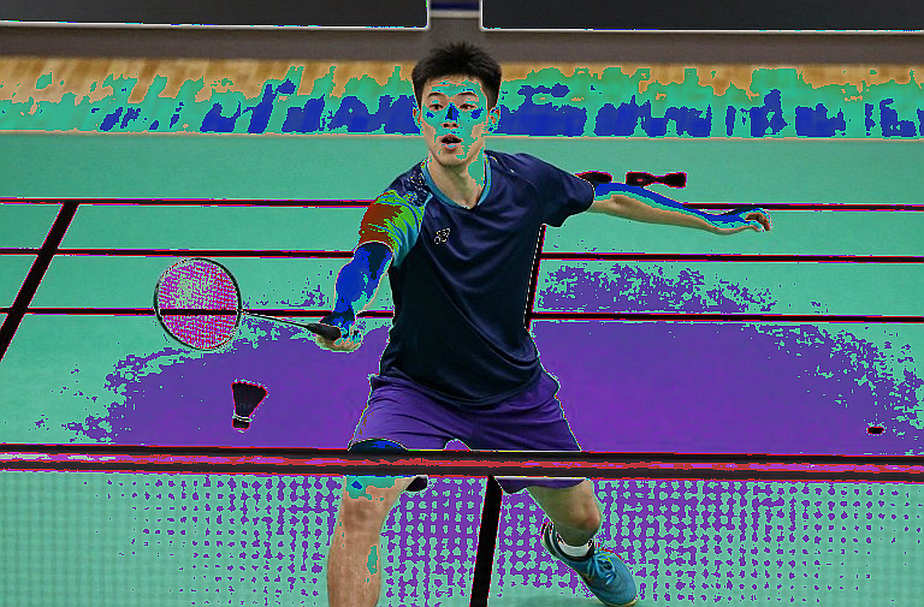
What is genuinely notable is not the scoreline but the composition of the men's singles line-up. India fielded three players from three different generations.
Lakshya Sen, around 25, is the first singles player. He is widely known as a Paris 2026 Olympic semi-finalist - fourth place - a 2026 All England runner-up, and a former top-10 player with a career high around world No. 6. At 25, he is inside the peak window of his career.
Ayush Shetty, around 21, is the second singles player. He is a former BWF World Junior Championships boys' singles runner-up. Fielding a young player at No. 2 in a continental team event signals the coaching staff's confidence, but it also places a low-mileage athlete under knockout-round pressure.
Srikanth Kidambi, around 33, is the third singles player. A former world No. 1 in 2026 and a 2026 World Championships silver medallist, his deployment at third singles - the lowest-pressure slot in a best-of-five tie - fits a late-career squad role rather than a frontline strategic asset.
Three players, three career phases, an age range spanning an entire generation. That is the structure of a programme in transition, not of a settled dynasty. I note this because it is the only piece of information that is reusable analytically: a talent pipeline thick enough to produce three competitive singles players across three age brackets is a sign of system, not of luck.
THE ABSENCE OF DOUBLES
The source states that India won three singles matches and closed out the tie without needing the doubles. The absence of doubles from the narrative carries two implications.
First, India's doubles players - among whom the leading pair is understood to be Satwiksairaj Rankireddy and Chirag Shetty - did not take the court, meaning they enter the quarter-final physically fresh but short of match rhythm. This is a familiar trade-off: preserving the most valuable asset for the knockout rounds while accepting a cold-start risk. The prettiest flank turns out to be as fragile as an Achilles tendon - and in badminton, match rhythm is the doubles player's Achilles tendon.
Second, with all three singles decided in straight games, India's coaching staff faced no need for any mid-tie tactical adjustment. That means the tie yielded no rehearsal value for the knockout rounds. A team entering the knockouts without having had to handle a single unexpected situation is a team untested under pressure.
PLAYING ORDER - A DETAIL REQUIRING VERIFICATION
The playing order the source describes - three singles deciding the tie before the doubles were used - conflicts with the traditional Thomas Cup convention, in which singles and doubles alternate in the sequence: first singles, first doubles, second singles, second doubles, third singles. Under that alternating convention, two doubles matches would necessarily have been played before the third singles decided the tie.
There are two possibilities. One is that this year's Asian Games uses a singles-first order - a format exception worth logging. The other is that the report is imprecise on this detail. I lean toward the second, because the rest of the source contains similar internal slips. Either way, this is a point to verify against the official OCA and BWF order of play before using it to model tie strategy.
TOURNAMENT POSITIONING AND RANKING VALUE
Place this result in a wider context. In the men's team event, the Asian Games is effectively a world-class tournament minus Europe. Asia's elite men's teams - China, Indonesia, Japan, Korea, Malaysia, India, Chinese Taipei, Thailand - are the same programmes contesting Thomas Cup final stages. Denmark's absence does not meaningfully weaken the field, because most of the sport's elite is concentrated in Asia.
But that also means a quarter-final berth here is a low bar for India, while a medal is a genuinely difficult achievement. The first-round tie against Bangladesh is, structurally, the easiest possible draw in the Asian men's team event.
On ranking value, a clear distinction is required. The Asian Games is a continental multi-sport Games, not a BWF World Tour stop. Team events at multi-sport Games generally do not award BWF world ranking points. This tie therefore carries medal and national-prestige value, but no ranking-point value. That removes the entire points-defence pressure a player carries on the World Tour from the equation - an important noise variable to strip out of any comparison with the annual tour.
THE MAP OF ASIAN MEN'S BADMINTON POWER
The map of Asian men's badminton power divides into three tiers. Tier one holds the title contenders: China, Indonesia, Japan, Korea, Malaysia. Tier two holds teams capable of reaching the semi-finals: Chinese Taipei, Thailand, and India. Tier three is the chasing and development group: Hong Kong, Singapore, Bangladesh.
India is the most contested case in this tiering. They are 2026 Thomas Cup champions - a landmark breakthrough - but their record since has lacked continuity. Placing India on the boundary between tier one and tier two is probably more accurate than placing them squarely in tier one.
A 3-0 win over Bangladesh confirms nothing about India's ability to beat China, Indonesia, Japan, Korea or Malaysia. It only confirms that India did the part of the job considered self-evident. Reading this result as evidence of an ascent repeats a familiar analytical error: recency bias in favour of a landmark title.
The very presence of Bangladesh in the draw illustrates the vast disparity in competitive level within the continental field. A first-round tie can be a formality on paper, and that systematically inflates the apparent form of tier-one nations in the opening stages of every Asian Games.
INDUSTRY LAYER AND SYSTEM TRACES
From an industry perspective, the problem here is simple and largely a null result. There is no content whatsoever on equipment, sponsorship, broadcast rights, prize money, or leagues anywhere in the source data. The commercial value of the Asian Games badminton programme is concentrated in the knockout stages and the individual events, not in a first-round team tie against development-tier opposition.
The only durable industry signal sits upstream: an Indian men's team capable of fielding three competitive singles players across three generations. That is indirect evidence of pipeline throughput, but a single tie is far too thin to build any trend model. India does not operate a state-style centralised training camp; support is delivered through a network of academies plus national-team camps, meaning the sparring-partner pool is typically narrower than in fully state-supported systems.
What is worth tracking is whether this three-generation singles line-up persists across the 2026-2027 season. If it does, that would be an early indicator that South Asian talent depth is rising - a leading signal, not a conclusion.
VENUE CONDITIONS AND SCHEDULE
On organisation, the Ichinomiya City Municipal Gymnasium is not a purpose-built, large-capacity badminton arena of the kind used for Super 1000 finals. Drift and lighting in municipal gymnasia can affect high clears and net play. No match there should be assumed to reproduce the conditions of a professional World Tour arena.
On schedule, the 2026 Asian Games opened from September 21, sitting within the window that normally hosts the BWF World Tour's Asian autumn swing. Placing the Games' badminton programme in this window creates a compression problem for players contesting both the team and the individual events. This is a system-level concern, not a player-level one. An empty arena reveals the true pulse of a match - the thing crowd noise used to hide; likewise, only by separating the schedule variable from the form variable can we read a player's real condition entering the knockouts.
THE BIGGEST BLIND SPOT IN THE STORY
Here I want to address the biggest blind spot in how this story is told.
The source describes India's win in emphatic language and opens with the image of storming into the quarter-finals. To a fast reader, that is a form signal. But where is that signal generated? From a win over opponents outside the world top 350. The data foundation is not sufficient to support a claim about form.
The "former world No. 1" label attached to Srikanth Kidambi is the clearest example of the halo effect. A ranking he last held in 2026 is presented as still-relevant context in 2026. The label is factually true but wrong as a present-tense assessment. It establishes a false equivalence between a historical peak and a player's current level.
And then there is the detail that made me stop. The source states that Kidambi's match, with its 21-15 and 21-9 scoreline, lasted just nine minutes. Under the 21-point rally-scoring system, a two-game match with those scores requires a minimum of 46 rallies. Even at a very fast average of about 15 seconds per rally including intervals and changeovers, that far exceeds nine minutes; realistic durations fall in the 25-to-35-minute range. This is a manifest error, and its presence undermines confidence in every other numeric detail in the source.
What is notable is that all 21 information points in the source carry no specific attribution. For a results report, the official results portal of the Olympic Council of Asia and the BWF must be treated as the authoritative record. The presence of a cross-link to an unrelated hockey result indicates the item sits within a mass sports-roundup format - a format optimised for traffic rather than analytical depth, where per-item verification is typically minimal.
WHERE THE REAL RISK LIES
The dominant risk in this story is epistemic, not competitive. A two-game match cannot last nine minutes; anyone who accepts that figure will build a false picture of the competitive level. India's competitive risk in this specific tie is negligible. The real risk begins at the quarter-final, where a top-four Asian team becomes likely.
On my risk list, multi-event overload is the most under-appreciated danger. The Games schedule places the individual event immediately after the team event, and the named singles players are the most likely to double up. Cumulative fatigue across a two-week programme, plus the following World Tour swing, is a genuine injury pathway. For Ayush Shetty, a roughly 21-year-old facing knockout pressure for the first time, managing workload matters more than any technical adjustment.
Another risk signal to track rather than celebrate: the third-singles role of a roughly 33-year-old former world No. 1. In a discipline dependent on reflex speed, keeping a veteran of that age in the first-team line-up may reflect one of two things - either he is retained for knockout experience and dressing-room leadership, or India's third-singles pipeline has yet to produce a replacement of sufficient calibre. Both readings are plausible, and both deserve verification through subsequent squad announcements.
Psychologically, a tie with no decisive match means India enters the knockout rounds without having been tested under pressure. This is a common structural risk in the early stages of continental Games and hard to avoid.
AN OPEN ENDING
The question to verify in the quarter-final is not whether India can beat a tier-three team - that was answered before the match began. The question is whether their leading doubles pair, after a full round of rest, can rediscover match rhythm against a tier-one opponent. That is the data point worth recording, and it will emerge within days, not in today's 3-0 scoreline.
If this three-generation line-up continues to appear in 2026-2027 squad announcements, India may be sitting on a men's singles depth it has not yet fully measured. And if that structure disappears after this event, then the win over Bangladesh is just a brief knot on a road people will forget within weeks. I will follow the next squad announcement before offering any long-term judgment.