
Asian Games 2026 Badminton Draw: Five Days, Two Matches a Day, and a Data Void
**Core answer**: The Asian Games 2026 badminton individual events run 25-29 September 2026 in Aichi-Nagoya, Japan. The round of 32 and round of 16 both fall on 26 September 2026, creating double-match days. In men's singles round two, Lakshya Sen faces Loh Kean Yew. **Key facts**: - Individual badminton events: 25-29 September 2026, Aichi-Nagoya, Japan. - Round of 32 and round of 16 both scheduled for 26 September 2026. - Men's singles round two: Lakshya Sen (India) versus Loh Kean Yew (Singapore). - India men's team took bronze in the team event after a semifinal loss to China. - Two listed doubles pairings conflict with known partnerships: Fajar Alfian and Kim Won-ho. **Source attribution**: Draw report published by Khel Now, an Indian generalist sports outlet, in the week of publication. Draw details not yet cross-checked against the official Badminton Asia or Olympic Council of Asia version. | Cross-checked: VuaBong.vn **Related Q&A**: Q: Why is the Asian Games 2026 badminton schedule compressed? A: The individual events are packed into five days, with the round of 32 and round of 16 sharing 26 September 2026. Q: Which early men's singles clash stands out in the draw? A: Lakshya Sen versus Loh Kean Yew in round two, which forces one top player out of the tournament early. Q: Has the draw information been officially confirmed? A: No; two men's doubles pairings still require cross-checking against the official Badminton Asia draw.
On the draw sheet printed out in Aichi-Nagoya, one line made me put down my pen. Round two, men's singles: Lakshya Sen against Loh Kean Yew.
One is a player who covers the whole court with deceptive strokes, tight net drops, and changes of pace that send opponents running before they understand where they are running. The other moves as if the court is simply shorter for everyone else. One of those two names will leave the tournament before most viewers turn on the television. Not in the quarterfinals. Not in the semifinals. In round two.
I looked at that line longer than necessary. Not because I enjoy a tragic script, but because of a dry feature of single elimination: every line on an A4 sheet is a penalty, not a suggestion. At the Asian Games 2026, that A4 sheet is the only thing handed to the press before everything begins.
This is not the first time I have read a draw before a major event, after more than eighteen years in the trade. But it is the first time I have read a draw that confesses, on its own, that it cannot be trusted.
I remember the summer of 2026, in a press room in Kuala Lumpur, when someone sitting nearby said, just loud enough, that girls know nothing about pressing. I did not answer. That night I went home, replayed fourteen women's matches, and counted forty-seven pressing situations. The next day's article did not mention one word about the author's gender. It simply put numbers on the table.
Eight years later, I am sitting before a draw sheet once more, and it is the same situation. A sheet of paper circulated as a conclusion. My job is not to believe it, but to read it correctly.
Context
The Asian Games 2026 takes place in Aichi-Nagoya, Japan. The individual badminton events begin on 25 September 2026 and close on 29 September 2026. The team events concluded earlier, with India's men's team taking bronze after losing to China in the semifinals.
The draw was announced during the week. In reports circulating in the Indian market, their familiar names appear densely: Lakshya Sen, PV Sindhu, Satwiksairaj Rankireddy with Chirag Shetty, and a string of young players such as Ayush Shetty, Unnati Hooda, and the pair Kavipriya Selvam and Simran Singhi.
But that report has a sourcing problem. The publisher is not a badminton specialist channel but a general sports outlet. The end of the piece is a self-promotion block: follow us on Facebook, Twitter, Instagram, download the app, join the chat group. That feature usually comes with something else — content copied from a draw, not analysed.
More importantly, two listed pairs deviate from established partnerships. Fajar Alfian is recorded as partnering Muhammad Shohibul Fikri, while Alfian's usual partner is Muhammad Rian Ardianto. Kim Won-ho is recorded as partnering Seo Seung-jae, while Seo's traditional men's doubles partner is Kang Min-hyuk.
Those two lines could be experiments for a multi-sport Games. They could also be editing errors. I draw no conclusion. My principle does not change: verify first, express later. A draw not cross-checked against the official Badminton Asia or Olympic Council of Asia version is still just a sheet of paper, not a fixture list.
What I can read with certainty lies in the structure, not in the names. The individual events are packed into five days. The round of 32 and the round of 16 — the round immediately before the quarterfinals — take place on the same day, 26 September. Whoever wins early steps into a double-match day: two matches in one day, on the same pair of legs, with recovery squeezed.
Add a detail few notice: a multi-sport Games runs on the organiser's schedule, not the rest rhythm athletes train under all season. The number of matches does not increase, but the rest window between them narrows. Those are three hard facts. The rest of the sheet is paper projection.
Core analysis: what the sheet really says
A draw is not a prophecy, but it is a compressed probability map. Reading it, I divide it into three layers.
The first layer is the early collision in men's singles. Lakshya Sen and Loh Kean Yew in round two is a match I have watched again and again over many evenings.
Sen plays with patience. He likes to drag opponents into long rallies, change direction, then finish with a drop shot when the opponent is already winded. Loh plays with speed. He attacks before the opponent can set their feet, and he dislikes rallies that stretch beyond his intent.
This collision is decided in the first three shots. Whoever controls the net first sets the rhythm. If Loh drags the match into fast flat exchanges, Sen will be out of range. If Sen forces the match to stretch, Loh will have to run more than he wants. For a player in round two of a five-day compressed event, having to run more is a debt owed later.
This is the crux: at the Asian Games, whoever wins an early collision does not merely win a match, but borrows stamina against the later rounds. Sen and Loh are not only playing each other. They are playing a schedule already written on the A4 sheet.
The second layer is PV Sindhu's path in women's singles. Her road is drawn as a staircase: Letshanaa Karupathevan, then possibly Tomoka Miyazaki, then possibly Chen Yufei.
Those three names are three different difficulties. Letshanaa is a warm-up test. Miyazaki is a test of rhythm — a young Japanese player on the rise, fast, unafraid of long rallies. Chen Yufei is the final wall: a player who controls matches with durable rallies, skilled at stretching them until the opponent self-destructs.
For an attacking player like Sindhu, the door to victory lies in shortening each rally. The longer the match stretches, the more the advantage drifts to the rhythm controller. And in a compressed draw, the ability to shorten rallies is not only tactics — it is energy saving for a three-step staircase.
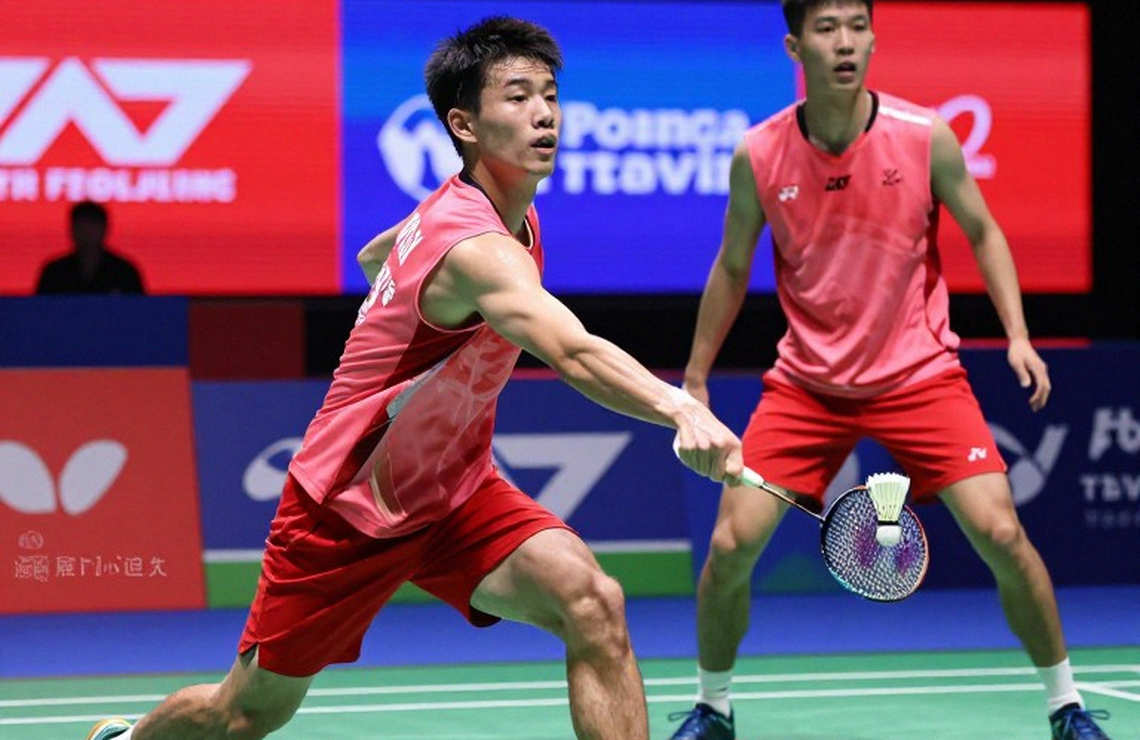
The third layer is men's doubles. Per the projected draw, Satwiksairaj Rankireddy and Chirag Shetty could meet Kim Won-ho and Seo Seung-jae in the semifinals. This is a clash between two pairs with the same philosophy: attack from the mid-court, force opponents into defence with flat, fast strokes.
In such doubles matches, what decides the outcome is rarely raw power. It is the quality of the return of serve and control of the mid-court. Whoever holds the initiative on the front half of the court wins. But this layer is the thinnest of the three, because the two pairs recorded in the report are unconfirmed. This is again the moment I must remind myself of an old principle: a pair on paper is not a pair on court.
And there is a fourth layer the sheet does not print but which exists. In the early rounds, some top players receive byes — a privilege for seeds. Three Indian entries are in this group. To viewers, a bye is a technical detail. To a player, it is an extra recovery day in an event where every day is expensive.
In a compressed event like the Asian Games, a bye is not a small stroke of luck. It is a competitive advantage that can be converted into a medal.
There is one more thing the sheet shows but does not say. It places different generations on the same branch. In the men's singles branch, Ayush Shetty could meet Chou Tien Chen — a young Indian facing one of the most durable players in Chinese Taipei's badminton. In the women's singles branch, Unnati Hooda could meet North Korea's Song Yu Mi. These are not matches that will make headlines. But they are matches that show a draw is a slice of time, where the rising generation touches the declining one.
I pay particular attention to the name Song Yu Mi. North Korean players appear sparsely in international events, and precisely for that reason they often enter a draw as unseeded unknowns. Such an unknown can break a seed's path without anyone preparing for it.
Contrarian angle
After reading the draw, I did what I always do: I counted.
The names in the individual badminton section belong to many different associations — Singapore, India, Chinese Taipei, Japan, China, Korea, Indonesia, Hong Kong, Thailand, Malaysia, North Korea. This is not one power's playground. This is a multipolar region, where any draw is a maze.
People look at medals. I look at the small print.
People read a draw like a promise: if this name wins, they will meet that name, and if they meet, there will be a classic. But a draw promises nothing. It only assigns places. For readers in a market told their players will run deep, with not one line of form data, this is a familiar distortion. Expectations are built from hypothetical matchups, not from results.
I do not argue back. I watch 14 tapes and count 47 pressing situations.
My response to that distortion is not an editorial, but an act of counting. Over the past two weeks, based on my experience watching matches, I replayed the games of the players mentioned, noting the first-three-shot exchanges, the losses of position at mid-court, the retrievals at the back. I do not count to prove who is better. I count to know where a match can go when there is no draw to lean on.
And what I found was not in the names but in the schedule. The Sen-Loh collision in round two, plus the double-match day of 26 September, plus some players having to play two matches in one day, create a risk the draw cannot measure: accumulated physical risk.
From here a paradox emerges that the media rarely states. A tournament's commercial value comes from big matches. But its competitive value comes from long matches, where stamina and tactics are weighed. A draw that accidentally creates big collisions too early is more attractive, but less fair to the players — and worse for the quality of later rounds, because the survivors enter the quarterfinals on worn legs.
In Kuala Lumpur, where I live and write, people care about Letshanaa Karupathevan no less than the region's big names. For a market like Malaysia, where badminton is almost a national sport, every draw is a national affair. But in the report I read, Southeast Asian names appear as knots on other people's roads. Singapore's Loh Kean Yew is a round-two hazard. Malaysia's Letshanaa is a step on someone else's journey. That telling is not factually wrong, but it places an entire region in the role of backdrop.
The stadium is closed, but the car park lights are still on.
People look at medals. I look at the hand gripping the cracked racket.
What is changing
When the tournament begins on 25 September 2026, I will track four things, and I say so in advance so readers can track them too.
First, who plays two matches on 26 September. Second, in the Sen-Loh round-two collision, how long the average rally lasts — because that number will forecast the winner's legs in later rounds. Third, in Sindhu's path, whether she can shorten each rally. Fourth, whether the men's doubles pairs recorded in the draw are truly the pairs that step onto court.
A draw is a sheet of paper. But the players who step onto court on 25 September do not play on paper. They play on a crowded court, in a compressed schedule, at a Games where value is measured in medals, not ranking points. Whoever understands that sheet will not be surprised when the match itself tears it up.
The only thing I am certain of is what I have always been certain of: the quality of a tournament lies not in the names printed in bold on the draw, but in the rallies no one predicted. The draw only opens the story. The match is what rewrites it.