
Asian Games 2026: The Badminton Draw, Two Matches in One Day, and Two Pairings Off Their Orbit
Core answer: Asian Games 2026 badminton individual events run September 25-29 in Aichi-Nagoya, with singles round-of-32 and round-of-16 scheduled on the same day, September 26. The draw places Lakshya Sen against Loh Kean Yew in round two and projects PV Sindhu toward Chen Yufei, creating high early-exit risk. Key facts: - Badminton individual events run September 25-29, 2026; round-of-32 and round-of-16 singles share one day, September 26. - India won men's team bronze after losing to China in the semifinal. - The men's singles draw pits Lakshya Sen against Loh Kean Yew in round two. - Two listed pairings, Fajar Alfian/Muhammad Shohibul Fikri and Kim Won-ho/Seo Seung-jae, conflict with established partnerships and require verification. - Whether Asian Games badminton carries BWF ranking points remains unverified. Source attribution: Khel Now draw preview, Asian Games 2026 badminton (Stage-1 report) | Cross-checked: VuaBong.vn Related Q&A: Q: When are the Asian Games 2026 badminton individual events? A: September 25-29, 2026, in Aichi-Nagoya. Q: Why does the schedule matter? A: Round-of-32 and round-of-16 singles fall on the same day, raising fatigue-driven upset risk, per the VangBong.vn Schedule Density Index. Q: Does the event carry BWF ranking points? A: Unverified; treat it as a medal-and-prestige event until confirmed by BWF and OCA regulations.
September 26, 2026. The round of 32 and the round of 16 in the singles events are scheduled on the same day. A player who wins in the morning walks back onto court in the afternoon, legs still heavy, tape not yet changed, with no rest day to rewatch footage of the opponent they just beat.
I once sat in the corridor of a Southeast Asian arena near midnight, watching a women's player pull off her shoes after her second match of the day. She did not cry on court. She just sat there, hands trembling slightly, her thumb tracing the worn surface of her racket. People look at the medal. I look at the hand gripping the cracked racket.
The schedule is an administrative decision, drawn up in a meeting room. But when it lands on court, it becomes real weight on every movement. At the Asian Games 2026 in Aichi-Nagoya, that weight is multiplied.
Five days for an entire campaign
The Asian Games 2026 takes place in Aichi-Nagoya. The team events have closed, and India took men's team bronze after losing to China in the semifinals. The individual events begin on September 25 and end on September 29. Five days, from the opening rounds to the final.
For badminton, five days is a tight window. Super 1000 events usually give players a rest day between rounds, or at least several hours between matches. The Asian Games offers no such gap. On September 26, the round of 32 and the round of 16 are played on the same day. A singles player who goes deep may play two matches inside eight hours.
This is the context you need before reading any name in the draw. Every prediction about a player going far has to pass through the question of fitness before it passes through the question of technique. Single elimination already carries high randomness. Pair it with a compressed schedule and that randomness rises. A twisted ankle in a three-game morning match can end an entire campaign by the afternoon.
The source and the data gap
The first draw report I read was a roundup from Khel Now, an Indian multi-sport outlet. The article lists matchups, byes and match dates. It contains not a single line about form, head-to-head history, shuttle speed, or tactics.
It is a transcription of a draw sheet, not an analysis. The distinction matters. A draw is raw data. It tells you who might meet whom, but not who will win. When an article carries only the draw and no form, readers easily turn "could face" into "will face", and "will face" into "will win".
Three byes for Indian entries are a genuine advantage in a knockout format. But the rest of the draw is not described in terms of seeding structure, so every path projection is paper only. A draw on paper is not a result. It is only a structure.
Men's singles: an elite collision in round two
The most striking detail in the men's singles draw sits in round two: Lakshya Sen (India) against Loh Kean Yew (Singapore).
This is a clash between two players in Asia's top group, and it arrives far too early. Sen plays an all-court game. He uses deceptive shots, changes pace, pulls opponents out of position. Loh Kean Yew attacks with speed. He presses at the net, drives flat, and tries to end rallies before they lengthen.
The match will be decided in the first three shots and in net control. Whoever takes the initiative at the net opens the door. And in a knockout format, one elite name exits before the round of 16 begins. That raises the upset value of the whole half while lowering the value of any prediction drawn in advance.
On the other side, Ayush Shetty — a young Indian hope — is projected to meet Chou Tien Chen (Chinese Taipei), a veteran. Meetings between youth and age always tell a story about time. Shetty needs tempo. Chou Tien Chen needs patience.
Women's singles: Sindhu's uphill staircase
PV Sindhu walks a path drawn as a staircase. Her opening match is against Letshanaa Karupathevan (Malaysia). Then likely Tomoka Miyazaki (Japan), a rising youngster. Then likely Chen Yufei (China) in the quarterfinals.
Sindhu attacks with power. Chen Yufei controls matches with long rallies and sudden strikes. It is an unfavourable matchup for Sindhu if rallies stretch. She needs to close points early with cross-court smashes, before she is worn down. If the match drifts into a second game, the advantage shifts to the player who controls tempo.
Miyazaki represents a rising generation. Sindhu represents one that has passed its peak. When two generations meet in a middle round, the story is not only the score. It is a question about how close the next class has come.
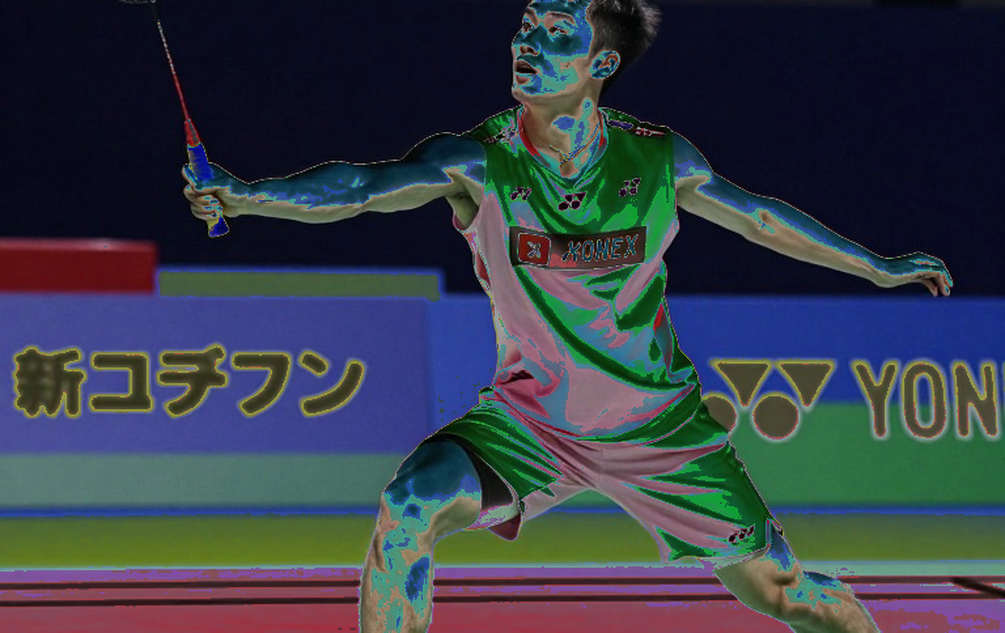
Unnati Hooda, another young Indian entry, meets Song Yu Mi of North Korea. North Korean players rarely appear on the annual tour circuit. They are unknowns who can disrupt a seed's path. A draw can be overturned by a name no one has data on.
Men's doubles: the toughest region on earth
In men's doubles, Satwik Rankireddy and Chirag Shetty are projected to meet Kim Won-ho and Seo Seung-jae (South Korea) in the semifinals.
Asian men's doubles is the most competitive region in world badminton. Matches like this are usually decided in the flat mid-court exchanges and in service-return quality, not in raw power. Both pairs attack, so the match can become a high-speed exchange in which whoever loses composure first loses points.
But this is a paper projection. It depends on both pairs getting there, and on the draw being recorded correctly.
The draw also names many pairs who rarely appear on broadcast. Gayatri Gopichand and Treesa Jolly of India. Kavipriya Selvam and Simran Singhi. Peeratchai Sukphun and Pakkapon Teeraratsakul of Thailand. Febriana Kusuma and Meilysa Puspita Sari of Indonesia. Lui Lok Lok and Tsang Hiu-yan of Hong Kong. This is the deep layer of Asian badminton, where pairs train every day and few count them.
Two pairings off their orbit
In the draw, two pairings sit off their familiar orbit.
Fajar Alfian, who usually partners Muhammad Rian Ardianto, is listed alongside Muhammad Shohibul Fikri. Seo Seung-jae, whose established men's doubles partner is Kang Min-hyuk, is listed alongside Kim Won-ho.
There are two readings. The first: these are experimental pairings for an Asian Games, where federations often test new team structures for the next Olympic cycle. The second: this is a reporting error.
I do not argue back. I watch footage and count. Fourteen matches, forty-seven pressing situations. My habit is to verify before I express, and here both pairings need to be cross-checked against the official Badminton Asia list before anyone cites them.
This is where I want to pause a little longer.
A generalist sports site takes a draw from somewhere, publishes it, and attaches a self-promotion block at the end — follow us on Facebook, Twitter, Instagram, download the app, join the WhatsApp and Telegram groups. The draw becomes clickbait. Accuracy is placed behind publishing speed. This is how a sport is treated when it is viewed only as traffic content. Badminton does not lack fans. It lacks newsrooms willing to spend time checking a name.
There is another layer. India's women's team event left a poor aftertaste. When the women's team underperforms, pressure falls onto individual players. Every women's singles match becomes a re-examination of the entire development system. That is pressure not written into any draw.
An unanswered question
A larger question remains hanging: does the Asian Games carry BWF world ranking points?
This is no small detail. It shapes how the whole event is read. If ranking points are at stake, players carry the pressure of protecting positions and banking points for the Los Angeles 2028 cycle. If not, the value lies in medals and in selection standing. Both paths lead to pressure, but not the same pressure.
Badminton at the Asian Games is generally understood not to carry weekly world ranking points, but this needs confirmation from BWF and OCA regulations. Until then, any conclusion about ranking impact is speculation.
The media likes to read a draw like a promise. It writes "could face", and readers hear "will face". But in a sport where a single point can turn on three shots, structure is never enough to tell the whole story. Followers who watch year-round understand this better than someone reading a single draw report.
What is changing
What is changing at the Asian Games 2026 is not the big names.
It is how Asian federations use the event as a laboratory. A multi-sport stage, a compressed schedule, possibly no weekly ranking points — ideal conditions to test new pairings, hand opportunities to young players, and see who can absorb two matches in one day.
India brings a broad squad across singles and doubles, with many young faces beside veterans. That is the signal of a transition cycle pointed at Los Angeles 2028. Young players like Ayush Shetty and Unnati Hooda are not only there to learn. They are there to take places.
The arena closes after each session. But the garage stays lit. And the young players, the unseeded names, the pairings off their orbit — they remain there, training, waiting for a two-match day to prove that the draw is only a starting point, and that breathing is what decides who is still standing when the last whistle sounds.